2026/03/15 8:22
**SBCL Fibers – 軽量協調スレッド**
RSS: https://news.ycombinator.com/rss
要約▶
本文
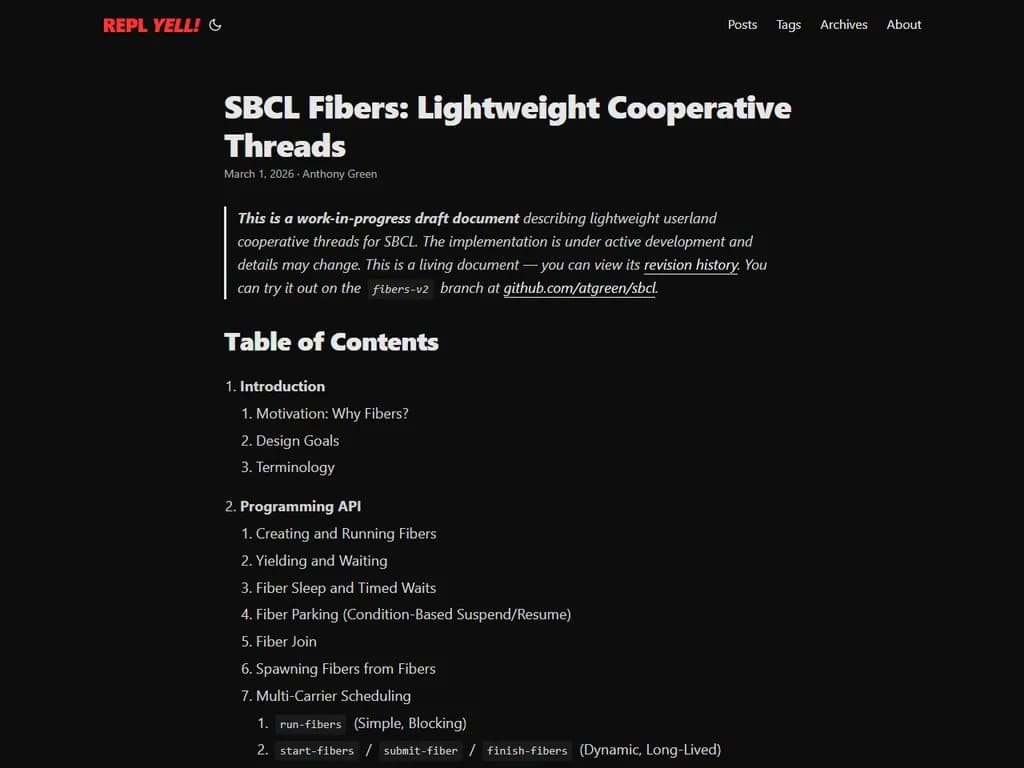
This is a work-in-progress draft document describing lightweight
userland cooperative threads for SBCL. The implementation is under
active development and details may change. This is a living
document — you can view its
revision history.
You can try it out on the
fibers-v2 branch at github.com/atgreen/sbcl.Table of ContentsIntroductionMotivation: Why Fibers?Design GoalsTerminologyProgramming APICreating and Running FibersYielding and WaitingFiber Sleep and Timed WaitsFiber Parking (Condition-Based Suspend/Resume)Fiber JoinSpawning Fibers from FibersMulti-Carrier Schedulingrun-fibers (Simple, Blocking)start-fibers / submit-fiber / finish-fibers (Dynamic, Long-Lived)Fiber-Aware Blocking PrimitivesMutex AcquisitionCondition VariablesSemaphoresI/O (wait-until-fd-usable)sleep and wait-forFiber Pinning (Preventing Yield)Introspection (list-all-fibers, fiber-state, Backtraces)Idle HooksAPI Reference SummaryArchitecture OverviewCarrier Threads and SchedulersFiber Lifecycle State MachineData Flow: Yield and ResumeContext SwitchingRegister Save/Restore ConventionThe fiber_switch Assembly RoutineStack Frame Initialization for New FibersThe Entry Trampoline (Assembly to C to Lisp)Zero-Allocation Design (No SAPs, No GC Pressure)Thread Register Patching on Carrier MigrationStack ManagementControl Stack Layout and Guard PagesBinding Stack (Separate Allocation)Stack Pooling (madvise(MADV_DONTNEED) Recycling)Stack Overflow Detection in Signal HandlersStack Size Tradeoffs (No Dynamic Growth)Dynamic Variable Bindings (TLS)The Problem: unbind_to_here Zeroes EntriesTLS Overlay Arrays (Save/Restore Without Unbinding)Carrier Value Update on MigrationCatch Block and Unwind-Protect Chain Save/RestoreEmpty Binding Stack Fast PathSame-Carrier Resume OptimizationGarbage Collector IntegrationThe Two-List Design: Suspended Fibers vs. Active Contextsfiber_gc_info: Conservative Control Stack Scanningactive_fiber_context: Carrier + Fiber Stack VisibilityPrecise Binding Stack ScavengingPersistent Carrier Context (Lock-Free Hot Path)The fiber-context Thread Struct Slot (O(1) Lookup)GC Safety Windows (without-interrupts vs. without-gcing)Correctness Argument: Why Partial Updates Are SafeScheduler DesignThe Scheduler LoopFast Path: Skip Maintenance When Deque Is HotMaintenance: Pending Queue Drain, Deadline Expiry, Wake ChecksPost-Switch Dispatch (Suspended, Dead)Idle Detection and Carrier ParkingMaintenance Frequency Backstop (Every 64 Fibers)Work StealingChase-Lev Lock-Free DequeOwner Operations (Push/Pop from Bottom, LIFO)Thief Operations (Steal from Top, FIFO, CAS)Buffer Growth (Power-of-Two Circular Array)Random Victim SelectionFiber Migration and Thread Register FixupI/O MultiplexingPlatform Abstraction (epoll, kqueue, poll Fallback)Edge-Triggered Mode with One-Shot (EPOLLET | EPOLLONESHOT)Indexed I/O Waiters (fd-to-Fiber Table)Bounded Epoll Drain Loopfd-ready-p and wait-until-fd-usable IntegrationThe Default I/O Idle HookBatched FD Polling vs. Per-Fiber PollingDeadline SchedulingBinary Min-Heap with Inline IndexO(log N) Insert and RemoveBatch Expiry (Pop All Expired in One Pass)Interaction with I/O Waiters (Dual-Indexed Fibers)Fiber Death and CleanupThe Lisp Trampoline (fiber-trampoline)Error Handling and Result CaptureBinding Stack Cleanup on Death (Without unbind_to_here)GC Info Unregistration TimingStack Return to PoolIntegration with SBCLThread Struct Extension (fiber-context Slot)serve-event Dispatch (Fiber-Aware wait-until-fd-usable)sleep and wait-for DispatchMutex and Condition Variable DispatchPinned Blocking Fallback to OS Primitivespinned-blocking-action Warning/Error Policyinterrupt-threadDebugger IntegrationPerformanceHTTP BenchmarkMemory EfficiencyScalability Under High Connection CountsContext Switch MicrobenchmarkGC ImpactPlatform Supportx86-64 (Linux, macOS, Windows)ARM64ARM32PPC64PPC32RISC-VFeature Flag: :sb-fiberPlatform-Specific Assembly and I/O BackendsAppendix A: Using Hunchentoot with FibersThe Fiber TaskmasterTaskmaster MethodsStarting the ServerHow It WorksSSLConsiderations1. Introduction1.1 Motivation: Why Fibers?Many server workloads are concurrent but not parallel. A web server
handling 10,000 connections spends almost all of its time waiting for
network I/O; the actual computation per request is trivial. The
natural programming model is one thread of control per connection —
read a request, compute a response, write it back — but OS threads
are too expensive to use this way at scale.Each OS thread in SBCL carries a full-sized control stack (typically
8 MB), a binding stack, signal handling infrastructure, and a kernel
task_struct. Creating a thread requires mmap, clone, and TLS
setup; destroying one requires the reverse. Context switching between
threads requires a kernel transition, TLB management, and scheduler
bookkeeping. At 10,000 concurrent connections, this means 80 GB of
virtual address space for stacks alone, and the kernel scheduler —
designed for dozens to hundreds of runnable tasks — begins to degrade.The conventional alternative is event-driven programming: a single
thread multiplexes connections using epoll or kqueue, dispatching
callbacks on I/O readiness. This scales well but inverts control
flow. Sequential logic must be broken into state machines or
continuation chains. Error handling, resource cleanup, and debugging
all become harder. Backtraces show the event loop, not the logical
call stack of the request being served.Fibers offer a third option. A fiber is a user-space thread with its
own control stack and binding stack, scheduled cooperatively by a
library-level scheduler rather than the kernel. Fibers preserve the
sequential programming model — the code reads top-to-bottom like a
normal thread — while achieving the resource efficiency of
event-driven I/O. A fiber’s control stack is 256 KB by default (not
8 MB), context switching saves and restores six registers in user space
(not a full kernel transition), and thousands of fibers can share a
small pool of OS carrier threads.Common Lisp complicates this picture because the language carries
more implicit per-thread state than most: special variable bindings
live in a separate binding stack, non-local exits thread through
catch tags and unwind-protect chains, and all of these must be
saved and restored correctly across suspension points. A fiber
implementation that only switches the control stack will corrupt this
state. SBCL’s fiber implementation handles all of it: dynamic
bindings made within a fiber are local to that fiber,
unwind-protect cleanup forms run on fiber death, and
handler-case/handler-bind work as expected.1.2 Design GoalsThe implementation is guided by several priorities, roughly in order:Correctness under GC. SBCL uses a generational, compacting,
stop-the-world garbage collector. The GC must be able to find every
live Lisp object, including those on suspended fiber stacks and in
fiber binding stacks. Getting this wrong means silent heap corruption.
Every design decision in the fiber runtime is constrained by the
requirement that GC can fire at almost any point (the only exclusion is
without-gcing regions) and must see a consistent view of all fiber
state.Transparent integration. Existing SBCL code should work inside
fibers without modification. grab-mutex, condition-wait,
wait-until-fd-usable, sleep, and wait-for all detect when they
are running inside a fiber and yield cooperatively instead of blocking
the carrier thread. Code that is not fiber-aware does not need to
change. Code that cannot safely yield (e.g., in the middle of a
multi-step foreign library interaction) can pin the fiber, causing
blocking primitives to fall through to their OS implementations.Low per-switch overhead. The context switch hot path —
yield-to-scheduler-to-resume — must be fast, because fibers switch
far more frequently than OS threads. The implementation targets
sub-microsecond switches by using a hand-written assembly routine that
saves only callee-saved registers, performing zero heap allocation on
the switch path, and eliminating all mutex acquisitions from the
per-switch code.Scalability to many fibers. The system should handle tens of
thousands of concurrent fibers without degradation. This requires
small per-fiber memory footprint (256 KB + 16 KB stacks, pooled for
reuse), O(1) or O(log N) scheduling operations, and efficient I/O
multiplexing that avoids per-fiber polling.Multi-core utilization. A pool of carrier threads should keep all
cores busy when there is enough work. Idle carriers should not waste
CPU. Work should migrate between carriers without programmer
intervention. The implementation uses lock-free work-stealing deques
(Chase-Lev) so that busy carriers never contend on a shared queue, and
idle carriers can take work from busy ones without locks.1.3 TerminologyFiber: A lightweight cooperative thread with its own control
stack and binding stack, scheduled in user space.Carrier thread (or carrier): An OS thread that runs fibers.
Each carrier has its own scheduler. A fiber executes on exactly one
carrier at a time, but may migrate between carriers via work
stealing.Scheduler: A per-carrier structure that manages a run queue
(work-stealing deque), waiting lists, deadline heaps, and I/O
multiplexer state. One scheduler per carrier thread.Scheduler group: A collection of schedulers (one per carrier)
that cooperate via work stealing. The unit of fiber lifecycle
management: fibers are submitted to a group and results are collected
from it.Yield: A fiber voluntarily suspends itself, returning control to
its carrier’s scheduler. The scheduler may then run another fiber on
the same carrier.Resume: The scheduler restores a suspended fiber’s context and
transfers control to it.Pin: Temporarily prevent a fiber from yielding. While pinned,
blocking primitives fall through to their OS implementations,
blocking the carrier thread.Wake condition: A predicate function associated with a suspended
fiber. The scheduler calls it periodically; when it returns true,
the fiber becomes runnable.Deque (double-ended queue): The per-carrier run queue, a
Chase-Lev work-stealing deque. The owner pushes and pops from the
bottom (LIFO); thieves steal from the top (FIFO) via CAS.Work stealing: When a carrier’s local run queue is empty, it
attempts to take a fiber from another carrier’s queue. This
balances load across cores without centralized scheduling.2. Programming APIAll public symbols are exported from the SB-THREAD package. The
fiber API is available when SBCL is built with the :sb-fiber feature
(enabled by adding :sb-fiber to local-target-features.lisp-expr).2.1 Creating and Running FibersA fiber is created with make-fiber and submitted for execution on a
scheduler group. It does not begin running until the scheduler picks
it up.(make-fiber function &key name stack-size binding-stack-size initial-bindings)
function — a function of no arguments. This is the fiber’s
entry point. When it returns normally, all return values are captured
as a list in the fiber’s result slot (retrievable via fiber-result,
or as multiple values via fiber-join). If it signals an unhandled
error, the condition object becomes the result instead.name — an optional string for debugging. Appears in
print-object output and backtrace annotations.stack-size — the size of the fiber’s control stack in bytes.
Defaults to 256 KB. This is the usable region; an additional guard
page (typically 4 KB) is allocated below it for stack overflow
detection. Stacks are drawn from a per-size pool and recycled with
madvise(MADV_DONTNEED), so the cost of creation is usually a pool
hit rather than a fresh mmap.binding-stack-size — the size of the fiber’s binding stack in
bytes. Defaults to 16 KB. Each (let ((var val)) ...) or progv
form pushes a two-word entry (old value + TLS index), so 16 KB
accommodates 1024 nested special variable bindings. A guard page is
allocated above the usable region; overflow triggers a segfault with
a diagnostic message, just like control stack overflow.initial-bindings — an alist of (symbol . value) pairs.
These are established as dynamic bindings (via progv) before the
fiber’s function is called, analogous to the :initial-bindings
argument to sb-thread:make-thread. The values in the alist are
used directly (not evaluated); the caller is responsible for computing
them before passing the alist. This is the primary mechanism for
giving each fiber its own copy of a special variable:(make-fiber (lambda () (format t "A%" my-connection))
:initial-bindings `((my-connection . ,conn)))
After creation, a fiber is in the :created state. It must be
submitted to a scheduler before it can run (see Section 2.7).2.2 Yielding and Waiting(fiber-yield &optional wake-condition)
fiber-yield suspends the current fiber and returns control to the
carrier thread’s scheduler. The scheduler may then run another
fiber on the same carrier. When the fiber is eventually resumed,
fiber-yield returns normally and execution continues from the point
of suspension.If wake-condition is provided, it must be a function of no
arguments. The scheduler calls it periodically; when it returns a
true value, the fiber is moved from the waiting list to the run queue.
If wake-condition is nil, the fiber becomes immediately runnable
again (it is pushed back onto the scheduler’s deque and will be
picked up on a subsequent iteration).fiber-yield signals an error if called outside a fiber context or
if the fiber is pinned (pin-count > 0).The yield path is designed to be fast. It saves the fiber’s binding
stack pointer, catch block, and unwind-protect chain; optionally saves
TLS overlay values (skipped when the binding stack is empty); restores
the carrier thread’s binding state; and then performs a register-level
context switch back to the scheduler. The entire operation involves
zero heap allocation and zero mutex acquisition.2.3 Fiber Sleep and Timed WaitsSuspends the current fiber for at least seconds (which may be
fractional). Implemented by setting a deadline in the fiber struct
and yielding with no wake condition. The scheduler’s deadline heap
expires the fiber when get-internal-real-time passes the target.
This avoids allocating a closure for the wake condition — the
scheduler checks the deadline field directly.fiber-sleep integrates with the standard cl:sleep function.
When sleep is called inside a fiber, SBCL dispatches to
fiber-sleep automatically. If the fiber is pinned, sleep falls
through to the OS implementation (blocking the carrier thread).2.4 Fiber Parking (Condition-Based Suspend/Resume)(fiber-park predicate &key timeout)
fiber-park is the general-purpose suspension primitive. It
combines a wake predicate with an optional timeout:predicate — a function of no arguments. The scheduler
calls it during maintenance passes; when it returns true, the fiber
is woken.timeout — seconds (may be fractional) after which the fiber
is woken regardless of the predicate.Returns t if the predicate was satisfied, nil if the timeout
expired first.Internally, fiber-park stores the timeout as a deadline in the
fiber’s deadline slot and passes the predicate to fiber-yield.
The scheduler handles deadline expiry and predicate checking in its
maintenance loop, so fiber-park itself allocates nothing beyond what
the caller passes in. This two-channel wake design (predicate OR
deadline) is the building block for all higher-level waiting
operations: mutex acquisition, condition variables, I/O waits, and
fiber-join.For a pure timed wait with no wake condition, use fiber-sleep
(Section 2.3) rather than fiber-park with a dummy predicate.
fiber-park is intended for cases where you need to wait until a
condition becomes true.2.5 Fiber Join(fiber-join target &key timeout)
Waits until the fiber target completes and returns the fiber
function’s return values (via values-list), analogous to
join-thread. If the fiber terminated due to an unhandled error, the
single return value is the condition object; use fiber-error-p to
distinguish this from a normal return.Returns nil (single value) if the timeout expires first.
A fiber cannot join itself.;; Single return value:
(fiber-join child) => result
;; Multiple return values:
(multiple-value-bind (x y) (fiber-join child)
(format t "Got ~S and S%" x y))
;; Error checking:
(let ((result (fiber-join child)))
(if (fiber-error-p child)
(format t "Fiber failed: A%" result)
(format t "Fiber returned: S%" result)))
fiber-join works from two contexts:From a fiber: Parks the calling fiber with a predicate that
checks (eq (fiber-state target) :dead). This is cooperative —
the calling fiber yields and other fibers continue running on the
same carrier.From an OS thread: Spin-waits with 1 ms sleeps between checks.
This is the appropriate behavior for a thread that is collecting
results from a fiber group.2.6 Spawning Fibers from FibersA running fiber can create and submit new fibers using the same
make-fiber and submit-fiber API. The new fiber is submitted to
the current scheduler’s group (if any), making it visible to the
work-stealing infrastructure:(let ((child (make-fiber (lambda () (compute-something)))))
(submit-fiber (fiber-scheduler-group current-scheduler) child)
;; ... do other work ...
(fiber-join child))
There is no implicit parent-child relationship. The spawning fiber
is not suspended while the child runs; both are independently
schedulable. The parent must explicitly join if it needs the child’s
result.When submit-fiber targets a scheduler group, the fiber is pushed
onto a randomly chosen carrier’s pending queue (a thread-safe atomic
list) and a parked carrier is woken if one exists. If all carriers
are busy, the fiber remains in the pending queue until the next
maintenance pass drains it. This is safe to call from any thread,
including non-carrier threads and fibers on other carriers.2.7 Multi-Carrier SchedulingTwo API styles are provided: a simple blocking interface for
batch-style workloads, and a dynamic interface for long-lived server
applications.2.7.1 run-fibers (Simple, Blocking)(run-fibers fibers &key carrier-count idle-hook)
=> list-of-results
Creates a scheduler group with carrier-count carrier threads
(defaulting to the number of available CPUs, cgroup-aware on Linux),
distributes fibers
round-robin across the carriers, runs them all to completion, and
returns a list of their results in the same order as the input.
This is a convenience wrapper around start-fibers + finish-fibers.Typical use:(let ((fibers (loop for url in urls
collect (make-fiber (lambda () (fetch url))))))
(run-fibers fibers :carrier-count 4))
2.7.2 start-fibers / submit-fiber / finish-fibers (Dynamic, Long-Lived)For applications that submit work over time (e.g., a web server
submitting a new fiber per accepted connection):(start-fibers initial-fibers &key carrier-count idle-hook)
=> fiber-scheduler-group
Starts carrier-count carrier threads and distributes
initial-fibers round-robin. Returns a fiber-scheduler-group
handle immediately. All carriers run on background threads.(submit-fiber group fiber)
Submits a new fiber to the group. Atomically increments the group’s
active count (so carriers know not to exit), pushes the fiber onto a
randomly chosen carrier’s pending queue, and wakes a parked carrier
if one exists. This is safe to call from any thread.(finish-fibers group) => list-of-results
(fiber-group-done-p group) => boolean
finish-fibers blocks until all fibers in the group have completed,
then returns their results.
fiber-group-done-p is a non-blocking check that returns t when
the group’s active count reaches zero.The dynamic API is the intended interface for server integration.
A server’s accept loop creates fibers and submits them; the carrier
threads run them; the fibers yield on I/O and resume when data is
available. The carrier count controls parallelism, and work
stealing keeps all carriers busy regardless of which carrier a fiber
was submitted to.2.8 Fiber-Aware Blocking PrimitivesExisting SBCL blocking primitives detect fiber context and yield
cooperatively rather than blocking the carrier thread. This is the
key to transparent integration: library code that calls grab-mutex
or sleep works correctly inside fibers without modification.Each primitive follows the same pattern: check if running in a fiber
and if the fiber can yield (not pinned); if so, park the fiber with
an appropriate wake condition; if pinned, invoke the configured
pinned-blocking-action and fall through to the OS implementation.2.8.1 Mutex AcquisitionWhen a fiber calls sb-thread:grab-mutex and the mutex is contended,
the fiber parks with a predicate that checks whether the mutex state
is free. On wake, it attempts a CAS to acquire the mutex. If the
CAS fails (another fiber grabbed it first), the fiber parks again.
This retry loop is necessary because wake conditions are checked
periodically, not atomically with the state change.2.8.2 Condition Variablessb-thread:condition-wait in a fiber context: releases the mutex,
parks the fiber with a generation-counter predicate (woken when
condition-notify increments the waitqueue’s generation), re-acquires
the mutex on wake. The generation counter avoids lost wakeups —
if condition-notify fires between the mutex release and the yield,
the generation will already have changed when the predicate is first
checked.2.8.3 SemaphoresSemaphore operations (wait-on-semaphore, signal-semaphore) follow
the same pattern as mutexes: park until the count is positive, then
CAS to decrement.2.8.4 I/O (wait-until-fd-usable)(sb-sys:wait-until-fd-usable fd direction &optional timeout)
In fiber context, this registers the file descriptor with the
scheduler’s event multiplexer (epoll on Linux, kqueue on BSDs) and
parks the fiber. On Linux with epoll available, the registration
uses edge-triggered mode with one-shot (EPOLLET | EPOLLONESHOT):
the kernel delivers a single event when the fd becomes ready, then
disables the registration. This eliminates spurious wakeups and
avoids the thundering-herd problem when multiple fibers wait on
related fds.The scheduler’s idle hook calls epoll_wait when no fibers are
runnable, waking fibers whose fds have become ready. The fiber
stores its waited-on fd and direction in struct fields so the
scheduler can index into an fd-to-fiber table for O(1) dispatch.When epoll is not available (or on non-Linux platforms), the fallback
is a batched poll() call over all waiting fds.2.8.5 sleep and wait-forcl:sleep dispatches to fiber-sleep when called in a fiber context
(see Section 2.3).sb-ext:wait-for dispatches to fiber-park with the test function
as the predicate and the timeout converted to a deadline.2.9 Fiber Pinning (Preventing Yield)(fiber-pin &optional fiber)
(fiber-unpin &optional fiber)
(fiber-can-yield-p &optional fiber)
(with-fiber-pinned ((&optional fiber)) &body body)
Pinning increments a per-fiber counter; unpinning decrements it. A
fiber with a non-zero pin count cannot yield. Any attempt to call
fiber-yield while pinned signals an error.The purpose of pinning is to protect regions of code that cannot
tolerate suspension. The primary case is thread-affine foreign
state: many C libraries use thread-local storage internally (OpenSSL
contexts, database handles, GPU contexts). If a fiber yields
mid-interaction and is later resumed on a different carrier via work
stealing, the C library’s thread-local state belongs to the old
carrier — the fiber is now on the wrong OS thread. This should be
rare in practice, but pinning provides a simple guard against it.When a pinned fiber calls a blocking primitive (grab-mutex, sleep,
wait-until-fd-usable, etc.), the primitive detects the pin and falls
through to the OS implementation, blocking the carrier thread. The
variable pinned-blocking-action controls how this is reported::warn (default) — emits a warning identifying the fiber and
the operation.:error — signals an error.nil — silently falls through.This policy exists because blocking a carrier thread degrades
throughput for all fibers on that carrier. The warning helps
developers identify code that should either be restructured to avoid
blocking while pinned, or that legitimately needs to pin (in which
case the policy can be set to nil).with-fiber-pinned is the recommended interface. It pins on entry,
executes the body, and unpins in an unwind-protect cleanup form,
ensuring the pin count is always restored even if the body signals.2.10 Introspection (list-all-fibers, fiber-state, Backtraces)(list-all-fibers) => list
Returns a copy of the global fiber list. Includes all fibers that
have been created and not yet destroyed (i.e., all states: :created,
:runnable, :running, :suspended, :dead). The list is captured
under a mutex to provide a consistent snapshot.(fiber-state fiber) => keyword
Returns the fiber’s current state: :created (made but not yet
submitted), :runnable (on a run queue), :running (actively
executing on a carrier), :suspended (yielded with a wake condition
or deadline), or :dead (function returned or signaled).(fiber-name fiber) => string-or-nil
(fiber-result fiber) => list
(fiber-alive-p fiber) => boolean
fiber-result returns the fiber’s result values as a list (or a
single-element list containing the condition object on error) after
death. Use fiber-join to receive the values via values-list. fiber-alive-p is shorthand for
(not (eq (fiber-state fiber) :dead)).(print-fiber-backtrace fiber &key stream count)
Prints a full symbolic backtrace for a suspended fiber, using SBCL’s
standard debugger infrastructure. Produces the same human-readable
output as print-backtrace — function names, arguments, source
locations, and local variables. Internally it binds the debug stack
bounds to the fiber’s control stack and walks frames starting from
fiber-top-frame. Only works for :suspended or :created fibers;
a running fiber’s stack is live on a carrier and being actively
modified.2.11 Idle Hooks(make-fiber-scheduler &key idle-hook)
(start-fibers fibers &key carrier-count idle-hook)
(run-fibers fibers &key carrier-count idle-hook)
The idle hook is a function of one argument (the scheduler) called
when the scheduler has no runnable fibers but has suspended fibers
waiting for a condition. The hook’s job is to block the carrier
thread efficiently until something changes — typically by performing
I/O multiplexing.The default idle hook (fiber-io-idle-hook) calls epoll_wait (on
Linux) or a batched poll() (elsewhere) with a timeout derived from
the nearest deadline in the scheduler’s deadline heap. When an fd
event arrives, the corresponding fiber is moved to the run queue.Custom idle hooks are useful for integrating fibers with external
event sources that are not file descriptors. For example, a message
queue consumer might check for new messages in its idle hook. The
hook should block for a bounded time (the default uses the nearest
deadline as its timeout) to ensure deadline-based fibers are not
starved.2.12 API Reference SummaryFunctionDescriptionmake-fiberCreate a fiber (does not start it)submit-fiberSubmit a fiber to a scheduler or grouprun-fibersCreate group, run fibers, return results (blocking)start-fibersCreate group and start carriers (non-blocking)finish-fibersBlock until all fibers complete, return resultsfiber-group-done-pNon-blocking completion checkfiber-yieldSuspend current fiberfiber-sleepSuspend for a durationfiber-parkSuspend until predicate or timeoutfiber-joinWait for fiber completionfiber-pin / fiber-unpinPrevent/allow yieldingwith-fiber-pinnedPin for duration of bodyfiber-can-yield-pCheck if fiber can yieldcurrent-fiberReturn current fiber or nilfiber-stateReturn fiber’s lifecycle statefiber-nameReturn fiber’s namefiber-resultReturn fiber’s result values (as list)fiber-error-pCheck if fiber terminated with an errorfiber-alive-pCheck if fiber is not deadlist-all-fibersSnapshot of all live fibersprint-fiber-backtraceSymbolic backtrace for suspended fibercurrent-fiberDynamic variable: current fibercurrent-schedulerDynamic variable: current schedulerpinned-blocking-actionPolicy for pinned blocking (:warn, :error, nil)3. Architecture Overview3.1 Carrier Threads and SchedulersThe fiber runtime is organized around a two-level hierarchy: carrier
threads and schedulers.Each carrier thread is a normal SBCL OS thread (sb-thread:thread)
that runs a scheduler loop. The scheduler loop pulls fibers from a
local work-stealing deque, runs them until they yield or die, handles
post-switch bookkeeping, and repeats. When the deque is empty, the
scheduler performs maintenance (draining pending queues, checking wake
conditions, expiring deadlines, polling I/O) and attempts work
stealing from sibling schedulers.A scheduler group (fiber-scheduler-group) binds multiple schedulers
together. Each group has a vector of scheduler structs (one per
carrier), a shared active-count for lifecycle tracking, a mutex and
condition variable for carrier parking, and a list of submitted
fibers for result collection.The separation between scheduler and group is deliberate. A single
carrier with a single scheduler is the simplest configuration: no
work stealing, no cross-thread coordination. Multiple carriers in
a group add parallelism via work stealing. The group’s active-count
is the coordination mechanism: carriers spin down when it reaches
zero; submit-fiber increments it atomically and wakes a parked
carrier.3.2 Fiber Lifecycle State MachineA fiber passes through five states: :created ──submit──> :runnable ──schedule──> :running
^ |
| yield/wake
| |
+────────────── :suspended
|
(or from :running)
|
v
:dead
:created — make-fiber returns a fiber in this state. It
has allocated stacks and a GC info record, but has not been
submitted to any scheduler.:runnable — submit-fiber or a wake event transitions the
fiber here. The fiber is on some scheduler’s deque or pending
queue, waiting to be picked up.:running — The scheduler has popped the fiber and is
executing it on a carrier. Exactly one fiber per carrier can be
in this state.:suspended — fiber-yield transitions here. The fiber has
a saved stack frame and optionally a wake condition, deadline, or
I/O wait registration.:dead — The fiber’s function returned (or signaled an
unhandled error). Results are captured, resources are cleaned up,
and the fiber is removed from the global list.3.3 Data Flow: Yield and ResumeA complete yield-and-resume cycle involves these steps:Yield (fiber → scheduler):Save the fiber’s binding stack pointer, catch block, and
unwind-protect chain into the fiber struct.Update the fiber’s gc_info binding stack pointer (so GC can
still scan the binding stack after the carrier’s BSP is restored).Save the fiber’s TLS overlay values and restore the carrier’s TLS
values (skipped if binding stack is empty).Restore the carrier’s BSP, catch block, and unwind-protect chain.Set fiber state to :suspended and store the wake condition.Call fiber_switch: save six callee-saved registers, write RSP to
the fiber’s saved-rsp slot, load RSP from the scheduler’s
saved-rsp slot, restore six registers, ret into the scheduler.Resume (scheduler → fiber):Save the carrier’s BSP, catch block, and unwind-protect chain.Update the active fiber GC context (fiber stack boundaries and
carrier stack scan range) — zero mutex locks.Set the carrier’s BSP to the fiber’s binding stack pointer.Restore the fiber’s catch block and unwind-protect chain.If the fiber has bindings: update carrier values in the binding
stack (only on migration) and replay the TLS overlay.Widen the fiber’s gc_info to cover the full stack (conservative
scan during the window before fiber_switch).Set effective stack bounds to the fiber’s stack.Call fiber_switch: save six registers, write RSP to the
scheduler’s saved-rsp slot, load RSP from the fiber’s saved-rsp
slot, restore six registers, ret into the fiber (at the point
after the yield’s fiber_switch call).On return: restore effective stack bounds, update or unregister
the fiber’s GC info, clear the active fiber context, restore the
carrier’s BSP.4. Context Switching4.1 Register Save/Restore ConventionThe fiber context switch saves only the callee-saved registers defined
by the platform ABI. This is the minimum set that a C or Lisp
function is entitled to assume is preserved across a call. All other
registers are either caller-saved (the compiler already assumes they
are clobbered) or are restored by normal function return.x86-64 SysV ABI (Linux, macOS): 6 registers (48 bytes)rbp, rbx, r12, r13, r14, r15x86-64 Win64 ABI (Windows): 8 GPRs (64 bytes) + 10 XMMs (160 bytes) = 224 bytesrbp, rbx, rdi, rsi, r12-r15xmm6-xmm15ARM64 (AAPCS64): 20 registers (160 bytes)x19-x28, x29 (FP), x30 (LR)d8-d15 (SIMD/FP callee-saved)ARM32 (AAPCS): 104 bytesd8-d15 (VFP, 64 bytes), r3-r11, lr (40 bytes)PPC64 (ELFv2): 320 bytesLR, CR, r14-r31 (18 GPRs), f14-f31 (18 FPRs)PPC32: 240 bytesLR, CR, r14-r31 (18 GPRs × 4 bytes), f14-f31 (18 FPRs × 8 bytes)RISC-V (RV64): 208 bytesra, cfp (for debugger), s0-s11 (12 GPRs), fs0-fs11 (12 FPRs)The choice to save only callee-saved registers (rather than the full
register file) is the primary reason fiber switches are fast. A
kernel context switch must save and restore all registers plus
segment registers, FPU state, and signal masks. A fiber switch saves
6 registers on x86-64 SysV (48 bytes), stores one pointer, loads one
pointer, restores 6 registers, and returns.4.2 The fiber_switch Assembly Routinefiber_switch is the core of the context switch. It is implemented
as a Lisp assembly routine (via define-assembly-routine) rather than
a hand-written .S file, which means it is assembled by SBCL’s
assembler and stored in the code heap alongside compiled Lisp
functions.The routine takes three arguments in ABI registers:old-slot: raw address of the word where the current RSP should
be saved (either a fiber’s saved-rsp slot or a scheduler’s
saved-rsp slot).new-slot: raw address of the word containing the target RSP to
load.thread-ptr: if non-zero, patch the thread register (r13 on
x86-64, x21 on ARM64) after restoring registers. This handles
carrier migration.The x86-64 implementation: push rbp ; save callee-saved registers
push rbx
push r12
push r13
push r14
push r15
mov [old-slot], rsp ; save current RSP
mov rsp, [new-slot] ; load target RSP
pop r15 ; restore callee-saved registers
pop r14
pop r13
pop r12
pop rbx
pop rbp
test thread-ptr, thread-ptr
jz done
mov r13, thread-ptr ; patch thread register
done:
ret ; return to caller on new stack
The ret is the critical instruction. When switching from a running
fiber to the scheduler, ret pops the return address that was pushed
when the scheduler originally called fiber_switch, returning
execution to the scheduler loop. When switching from the scheduler
to a suspended fiber, ret pops the return address from the fiber’s
stack, returning to the point just after the fiber’s fiber_switch
call inside fiber-yield.4.3 Stack Frame Initialization for New FibersA brand-new fiber has never been switched to, so its stack has no
saved registers. initialize-fiber-stack constructs a synthetic
stack frame that makes fiber_switch’s register restore sequence
“return” into the entry trampoline.On x86-64 SysV, the initial stack layout (from top, growing down): stack_top - 8: 0 (alignment padding)
stack_top - 16: 0 (spare slot)
stack_top - 24: trampoline_addr (return address for ret)
stack_top - 32: fiber_lispobj (popped into rbp)
stack_top - 40: 0 (popped into rbx)
stack_top - 48: 0 (popped into r12)
stack_top - 56: 0 (popped into r13)
stack_top - 64: 0 (popped into r14)
stack_top - 72: 0 (popped into r15)
^--- initial saved RSP
When fiber_switch loads this RSP and pops registers, rbp receives
the fiber’s lispobj (a tagged Lisp pointer to the fiber struct). The
ret instruction then jumps to fiber_entry_trampoline.4.4 The Entry Trampoline (Assembly to C to Lisp)fiber_entry_trampoline is the landing pad for first-time fiber
execution. It receives the fiber lispobj in rbp (placed there by
the synthetic stack frame) and:Moves the fiber lispobj into the first C argument register (rdi
on SysV, rcx on Win64).Clears rbp (no valid frame pointer for a new fiber).Calls fiber_run_and_finish (a C function).Terminates with hlt (unreachable; the C function does not
return).fiber_run_and_finish in turn calls a Lisp trampoline function
(fiber-trampoline) registered at scheduler startup. This Lisp
function runs the fiber’s user function with handler-case error
handling, captures the result, marks the fiber dead, cleans up
bindings, and switches back to the scheduler. The chain is:fiber_switch → fiber_entry_trampoline (asm)
→ fiber_run_and_finish (C)
→ fiber-trampoline (Lisp)
→ user function
The Lisp trampoline never returns; it ends with a fiber_switch back
to the scheduler. The hlt after the C call is a safety net.4.5 Zero-Allocation Design (No SAPs, No GC Pressure)The %fiber-switch VOP passes arguments as raw machine words, not
Lisp objects. The saved-rsp slot addresses are computed from the
fiber struct’s tagged pointer using arithmetic (adding the slot offset
and subtracting the lowtag), producing unsigned integers that never
become heap-allocated SAPs.This matters because SAP allocation can trigger GC, which would
move the fiber struct (invalidating the address just computed) and
require stopping the world at an inconvenient point. By keeping
everything as raw words, the switch path creates zero GC pressure.The TLS scratch hash table and overlay arrays are pre-allocated in the
scheduler and fiber structs, not on the switch path. The wake
condition closures are allocated by the caller before yielding.4.6 Thread Register Patching on Carrier MigrationSBCL reserves a machine register as a pointer to the current thread
struct: r13 on x86-64 (when gs-segment TLS is not used), x21
on ARM64. This register is set once when a thread starts and never
changes during normal execution.When a fiber migrates between carriers via work stealing, it was
suspended on carrier A with A’s thread pointer in its saved
registers. If it resumes on carrier B, the restored thread register
would point to A’s thread struct — the wrong thread.The resume-fiber-internal function handles this by passing the
current carrier’s thread SAP as the third argument to fiber_switch.
The assembly routine checks if this is non-zero and, if so, overwrites
the just-restored thread register with the correct value. This
happens after all other registers are restored but before the ret,
so the fiber resumes with a valid thread pointer on its new carrier.For same-carrier resumes (the common case), the third argument is
still passed (the current thread pointer), but the patching is
harmless — it sets the register to its already-correct value.5. Stack Management5.1 Control Stack Layout and Guard PagesEach fiber’s control stack is a contiguous region obtained via
os_allocate (mmap on Unix, VirtualAlloc on Windows). The
layout, from low to high address: +-------------------+ ← base (mmap'd address)
| Guard page (4 KB) | PROT_NONE — segfault on access
+-------------------+ ← control-stack-start (usable region)
| |
| Usable stack | 256 KB default (grows downward)
| |
+-------------------+ ← control-stack-end (stack top)
The guard page at the bottom catches stack overflow. When a fiber’s
stack pointer descends into the guard page, the hardware generates a
segfault. SBCL’s signal handler calls check_fiber_guard_page,
which walks both the active fiber contexts and the suspended fiber
GC info list to match the fault address against fiber stack ranges.
If matched, it calls lose() with a diagnostic message.The usable stack region is what the fiber’s code sees. RSP starts
at control-stack-end (the top) and grows downward toward the guard
page.5.2 Binding Stack (Separate Allocation)Each fiber has a separate binding stack for dynamic variable bindings.
This is a flat array of two-word entries (old value, TLS index),
allocated via alloc_fiber_binding_stack. The default size is 16 KB,
accommodating 1024 nested bindings.The binding stack grows upward (binding-stack-pointer increases with
each bind). A guard page (PROT_NONE) is placed above the usable
region, at the top of the allocation. If a fiber exhausts its
binding stack, the next bind writes into the guard page and triggers
a segfault. check_fiber_guard_page matches the fault address
against the binding stack guard regions in all_fiber_gc_info and
reports a diagnostic message via lose().The 16 KB default is generous for nearly all workloads; programs
that use deeply nested dynamic bindings can increase it via the
:binding-stack-size keyword to make-fiber.The binding stack is a separate allocation because its access pattern
differs from the control stack. The control stack is accessed
randomly (function calls, local variables); the binding stack is
accessed linearly (push on bind, pop on unbind). Keeping them
separate also simplifies GC scanning: the binding stack contains
only TLS indices and Lisp object references, scavenged precisely,
while the control stack is scanned conservatively.5.3 Stack Pooling (madvise(MADV_DONTNEED) Recycling)Creating a fiber requires two mmap calls (control stack + binding
stack) and destroying one requires two munmap calls. At high fiber
creation rates (e.g., one per HTTP request), these syscalls become a
bottleneck.The stack pool eliminates this cost. Two global pools (one for
control stacks, one for binding stacks) cache up to 4096 stacks each.
When a fiber dies and its stack is returned, the pool first calls
madvise(MADV_DONTNEED) on the usable region, which tells the kernel
to release the physical pages while keeping the virtual mapping. The
next access to those pages returns zero-filled memory from the
kernel’s page fault handler — effectively a fresh stack without an
mmap/munmap round trip.Pool lookup is O(1): each pool is a singly-linked free list protected
by a mutex. Stacks are pooled only when their size matches the
pool’s cached size (typically the default 256 KB or 16 KB); mismatched
sizes bypass the pool and are deallocated immediately. This avoids
complexity while handling the common case efficiently.The guard page’s PROT_NONE protection is unaffected by madvise,
so recycled control stacks retain their overflow protection without
needing to re-set page permissions.5.4 Stack Overflow Detection in Signal HandlersSBCL’s signal handler for SIGSEGV (or SIGBUS on some platforms)
calls check_fiber_guard_page to determine whether the fault address
is in a fiber’s guard page. This function walks two data structures:all_active_fiber_contexts — fibers currently executing on
carriers. Their fiber_stack_start marks the top of the guard
page.all_fiber_gc_info — suspended fibers. Their
control_stack_base marks the top of the guard page.If the fault address falls within one guard page width below a stack’s
start, the fiber has overflowed. The handler calls lose() with a
diagnostic message including the fault address and stack boundaries.5.5 Stack Size Tradeoffs (No Dynamic Growth)The default control stack size of 256 KB is a compromise. Smaller
stacks allow more concurrent fibers (10,000 fibers at 256 KB = 2.5 GB
virtual, versus 80 GB for OS threads at 8 MB), but too-small stacks
cause overflow in code that uses deep recursion or large
stack-allocated arrays.The binding stack default of 16 KB is conservative for most
workloads. Each let over a special variable or progv form pushes
one 16-byte entry, so 16 KB supports 1024 nesting levels. Server
request handlers typically use a handful of special variables.Both sizes are configurable per-fiber via make-fiber keywords.Dynamic stack growth (as seen in Erlang/BEAM processes) is not
supported. Fiber stacks are fixed-size mmap allocations; growing
them would require either relocating the stack (invalidating all
interior pointers, return addresses, and GC-conservative references)
or using discontiguous segments (requiring compiler support for
segment-crossing checks on every function call). Neither approach
is feasible within SBCL’s native-code compilation model. The
practical mitigation is to choose an appropriate stack size at
make-fiber time and use heap allocation for large data structures.6. Dynamic Variable Bindings (TLS)6.1 The Problem: unbind_to_here Zeroes EntriesSBCL implements special variable bindings as a thread-local storage
(TLS) array indexed by per-symbol TLS indices. When code binds a
special variable, the runtime pushes a two-word entry (old value at
offset 0, TLS index at offset +word) onto
the binding stack and writes the new value into the thread’s TLS
array. When the binding is unwound, unbind_to_here pops entries,
restoring old values and zeroing the binding stack entries.This create a problem for fibers. When a fiber yields, it must save
its TLS state and restore the carrier thread’s TLS state. But the
binding stack entries are the mechanism for tracking what needs to be
restored — and unbind_to_here destroys them. If we unwound the
fiber’s bindings on yield (calling unbind_to_here), the binding
stack would be zeroed out, and we would have no record of which TLS
indices were bound or what the fiber’s values were.The fiber implementation therefore never calls unbind_to_here during
yield or resume. Instead, it uses a TLS overlay approach.6.2 TLS Overlay Arrays (Save/Restore Without Unbinding)Each fiber has two parallel arrays: tls-indices and tls-values.
On yield, save-fiber-tls-and-restore-carrier performs a two-pass
walk of the binding stack:Pass 1: Count unique TLS indices using a scratch hash table
(pre-allocated in the scheduler struct to avoid consing).Pass 2: For each unique TLS index, save the current TLS value
(the fiber’s value) into the fiber’s tls-values array, then restore
the carrier’s value by writing the outermost old_value from the
binding stack into the TLS array.On resume, restore-fiber-tls-overlay replays the fiber’s saved
values back into the TLS array:(dotimes (i (length indices))
(setf (sap-ref-word thread-sap (aref indices i))
(aref values i)))
This is a simple indexed store loop with no hash lookups, no binding
stack manipulation, and no calls into the runtime. The binding stack
itself is never modified — it retains the full history of binds
needed for unwind-protect and error handling.6.3 Carrier Value Update on MigrationWhen a fiber migrates between carriers via work stealing, its binding
stack’s old-value entries still contain values from the previous
carrier’s TLS array. If the fiber later yields or dies, the restore
path would write the old carrier’s values into the new carrier’s TLS
— corrupting the new carrier’s state.update-binding-stack-carrier-values fixes this. Before replaying
the TLS overlay, it walks the binding stack and overwrites each
outermost old-value with the current carrier’s TLS value for that
index. This ensures that when the fiber yields, the carrier’s TLS
is restored correctly regardless of which carrier the fiber was
originally on.This operation is skipped on same-carrier resumes (the common case),
gated by a migration flag computed from
(not (eq (fiber-carrier fiber) current-thread)).6.4 Catch Block and Unwind-Protect Chain Save/RestoreBeyond the binding stack, SBCL maintains per-thread pointers to the
current catch block (current-catch-block) and the current
unwind-protect block (current-unwind-protect-block). These are
singly-linked lists threaded through the control stack, used by
throw, handler-case, and unwind-protect.On yield, the fiber saves these pointers from the thread struct into
fiber-saved-catch-block and fiber-saved-unwind-protect-block, then
restores the carrier’s values (saved when the fiber was mounted).On resume, the carrier’s values are saved and the fiber’s are
restored. For new fibers, these are zero (no catch or unwind-protect
blocks established yet).6.5 Empty Binding Stack Fast PathMany fibers (especially benchmark and compute-intensive fibers) never
bind any special variables. Their binding stack pointer equals their
binding stack start.The yield and resume paths check for this condition:(when (/= (fiber-binding-stack-pointer fiber)
(fiber-binding-stack-start fiber))
...)
When the binding stack is empty, the entire TLS save/restore sequence
is skipped: no hash table operations, no array allocation, no binding
stack walk. This fast path reduces context switch cost for fibers
that do not use dynamic bindings.6.6 Same-Carrier Resume Optimizationupdate-binding-stack-carrier-values is expensive: it walks the
entire binding stack with a hash table for deduplication. But it is
only needed when a fiber has migrated between carriers, because the
old-value entries already match the current carrier’s TLS if the fiber
hasn’t moved.The scheduler loop computes a migration flag:(let ((migrated (not (eq (fiber-carrier fiber) current-thread))))
...)
This flag is propagated to resume-fiber-internal, which guards the
carrier value update:(when migrated
(update-binding-stack-carrier-values fiber thread-sap scheduler))
In a single-carrier configuration or when work stealing is
infrequent, this eliminates the binding stack walk entirely from the
resume path.7. Garbage Collector Integration7.1 The Two-List Design: Suspended Fibers vs. Active ContextsThe GC needs to find all live Lisp objects, including those on fiber
stacks. Two data structures serve this purpose:all_fiber_gc_info — a doubly-linked list of fiber_gc_info
structs, one per fiber that has been created and not yet destroyed.
Each entry holds the fiber’s control stack base/pointer/end and
binding stack start/pointer. Used for scanning suspended fibers'
stacks.all_active_fiber_contexts — a doubly-linked list of
active_fiber_context structs, one per carrier thread that is
currently running a scheduler. Each entry holds the running
fiber’s stack boundaries and a nested carrier_gc_info that
represents the carrier thread’s suspended stack.During stop-the-world GC, all mutator threads are stopped. The
collector iterates both lists without locking (all writers are
stopped). For each suspended fiber, it conservatively scans the
control stack and precisely scavenges the binding stack. For each
active context, it scans the running fiber’s stack and the carrier’s
suspended stack.7.2 fiber_gc_info: Conservative Control Stack ScanningEach fiber’s fiber_gc_info contains:struct fiber_gc_info {
lispobj* control_stack_base; // mmap'd base
lispobj* control_stack_pointer; // saved RSP
lispobj* control_stack_end; // base + size
lispobj* binding_stack_start;
lispobj* binding_stack_pointer;
struct fiber_gc_info* next;
struct fiber_gc_info* prev;
int registered;
};
During GC, the collector scans words from control_stack_pointer to
control_stack_end:for (ptr = fi->control_stack_pointer; ptr < fi->control_stack_end; ptr++) {
lispobj word = ptr;
if (word >= BACKEND_PAGE_BYTES
&& !(exclude_from <= word && word < exclude_to))
preserve_pointer(word, 0);
}
The scan is conservative: every word that looks like a valid heap
pointer is treated as a potential reference, pinning the pointed-to
object. The self-reference exclusion (exclude_from/exclude_to)
prevents the stack’s own address range from being treated as heap
pointers.7.3 active_fiber_context: Carrier + Fiber Stack VisibilityWhen a fiber is actively running on a carrier, RSP points into the
fiber’s control stack, not the carrier’s. The normal thread scanning
code in gencgc.c would miss the carrier’s suspended frames (above
the point where fiber_switch was called).The active_fiber_context solves this with a nested carrier_gc_info
that records the carrier’s stack boundaries. The carrier’s
control_stack_pointer is set conservatively to
__builtin_frame_address(0) - 16384, ensuring that all frames
between the update_fiber_gc_context call and the actual suspension
point (inside fiber_switch) are included in the scan.The GC checks for active fiber contexts in two places:SP validation: If a thread’s interrupt-context SP does not fall
within the carrier’s control stack, the GC checks whether it falls
within the fiber’s stack via find_active_fiber_context.Stack scanning: If a fiber is active, the GC scans the fiber’s
stack (from SP to fiber_stack_end), then separately scans the
carrier’s stack (from carrier_start + 3page_size to
carrier_stack_end), skipping the guard pages.7.4 Precise Binding Stack ScavengingUnlike control stacks, binding stacks are scavenged precisely. Each
two-word entry has a known format (old value + TLS index), so the
collector can process them with scav_binding_stack rather than
conservative word-by-word scanning.For the active fiber, BSP points into the fiber’s binding stack:struct active_fiber_context* fctx = find_active_fiber_context(th);
if (fctx && fctx->fiber_binding_stack_start
&& !(bsp >= bs_start && bsp <= bs_start + BINDING_STACK_SIZE)) {
scav_binding_stack(fctx->fiber_binding_stack_start, bsp, ...);
}
For suspended fibers, the collector iterates all_fiber_gc_info:for (fi = all_fiber_gc_info; fi; fi = fi->next) {
scav_binding_stack(fi->binding_stack_start,
fi->binding_stack_pointer, ...);
}
7.5 Persistent Carrier Context (Lock-Free Hot Path)The original implementation called enter_fiber_gc_context and
leave_fiber_gc_context on every resume/yield, acquiring four mutex
locks per context switch (two for fiber_gc_lock, two for
active_fiber_context_lock). Under load, these global locks became a
bottleneck.The optimized implementation uses persistent carrier contexts:init_carrier_fiber_context() — called once when a carrier
starts its scheduler. Allocates the active_fiber_context,
registers the carrier_gc_info with empty ranges (pointer = end, so
GC scan loops execute zero iterations), links into
all_active_fiber_contexts, and stores the pointer in the thread
struct’s fiber-context slot. Two mutex acquisitions total.update_fiber_gc_context() — called per resume. Reads the
context from thread->fiber_context (no TLS lookup). Updates fiber
stack boundaries and carrier stack scan range. Zero mutex locks.clear_fiber_gc_context() — called per yield-return. Sets
fiber fields to NULL and carrier ranges to empty. Zero mutex
locks.destroy_carrier_fiber_context() — called once when a carrier
exits. Unregisters from both lists. Two mutex acquisitions total.This reduces per-switch mutex overhead from 4 to 0.7.6 The fiber-context Thread Struct Slot (O(1) Lookup)find_active_fiber_context is called by the GC for every thread
during stop-the-world. The original implementation walked the
all_active_fiber_contexts linked list to find the entry matching a
given thread — O(n) in the number of carriers.The optimized implementation stores the active_fiber_context pointer
directly in the thread struct:struct active_fiber_context*
find_active_fiber_context(struct thread* th) {
return (struct active_fiber_context*)th->fiber_context;
}
This required adding a fiber-context slot to the thread struct
definition in objdef.lisp:#+sb-fiber
(fiber-context :c-type "void " :pointer t)
The slot is set by init_carrier_fiber_context and cleared by
destroy_carrier_fiber_context. For non-carrier threads, it is NULL,
and find_active_fiber_context returns NULL (no fiber context to
process).7.7 GC Safety Windows (without-interrupts vs. without-gcing)Two SBCL mechanisms control GC timing:without-interrupts — defers delivery of asynchronous
signals (including the stop-for-GC signal) but does not prevent
GC from occurring if triggered by allocation within the body.without-gcing — prevents GC entirely (sets a flag that
causes allocation to block until the region exits).The yield and resume paths use without-interrupts for most of their
work. This prevents the stop-for-GC signal from arriving mid-update,
which could expose partially-written fiber state to the collector.Specific without-gcing regions protect narrow critical sections
where the GC must not fire:register_fiber_for_gc / unregister_fiber_for_gc — these
modify the all_fiber_gc_info linked list. If GC fired during
a list splice, the collector could follow a dangling pointer.Binding stack pointer update in gc_info — on yield, the
fiber’s gc_info binding stack pointer must be updated before the
carrier’s BSP is restored. Between these two operations,
without-interrupts alone does not prevent GC (an allocation could
trigger it), so the gc_info write is wrapped in without-gcing.7.8 Correctness Argument: Why Partial Updates Are SafeThe persistent carrier context design appears to have a race: the
update_fiber_gc_context call writes multiple fields (fiber stack
start, end, binding stack start, carrier stack pointer) without
holding any lock. Could GC see a half-updated context?No, because of SBCL’s stop-the-world GC protocol. Before the
collector reads any of these fields, it sends a stop signal to every
mutator thread and waits for all to reach a safepoint. Once stopped,
no thread is executing update_fiber_gc_context or
clear_fiber_gc_context. The fields are therefore always in a
consistent state when the GC reads them.The only edge case is the empty state: clear_fiber_gc_context sets
fiber fields to NULL and carrier ranges to empty. If GC reads this
state, it sees no fiber stack to scan and an empty carrier range (no
additional scanning). The carrier’s normal thread stack is still
scanned via the standard thread scanning path, so no objects are
missed.8. Scheduler Design8.1 The Scheduler LoopThe scheduler loop (run-fiber-scheduler) is the core of each
carrier thread. Its structure:init-carrier-fiber-context()
loop {
fiber = fast-path-pop() or (maintenance + pop-or-steal)
if fiber:
run-fiber(fiber)
handle-post-switch(fiber)
else if has-waiters:
idle-hook()
else if group-active:
park-carrier()
else:
return
}
destroy-carrier-fiber-context()
The loop runs until either all fibers in the group are dead (the
active count reaches zero) or, in single-carrier mode, the local
deque is empty and no fibers are waiting.8.2 Fast Path: Skip Maintenance When Deque Is HotThe common case in a busy scheduler is a non-empty deque. The fast
path tries wsd-pop at the top of each iteration. If it succeeds,
the fiber is run immediately without any maintenance work. This
avoids the overhead of epoll queries, deadline heap checks, and
waiting list walks when there is plenty of local work.A maintenance counter tracks how many fibers have been run without
a maintenance pass. When it reaches 64, a full maintenance cycle is
forced regardless of deque state. This backstop ensures that I/O
waiters and deadline-based fibers are not starved when the deque is
continuously fed by productive fibers.8.3 Maintenance: Pending Queue Drain, Deadline Expiry, Wake ChecksWhen the deque is empty (or the backstop fires), the scheduler
performs a full maintenance cycle:Pending queue drain — External threads (e.g., a server’s
accept loop) submit fibers to a scheduler’s pending list via
atomic-push. Maintenance atomically swaps the list to NIL (via
CAS) and pushes each fiber onto the local deque.Epoll harvest (Linux) — epoll_wait with timeout=0 drains
all pending I/O events into the scheduler’s ready-fds hash
table. %scheduler-wake-ready-io-waiters then moves ready
fibers from the io-waiters table to the deque.Deadline heap expiry — %heap-pop-expired pops all fibers
whose deadline has passed (comparing against a single
get-internal-real-time captured once per maintenance cycle) and
pushes them to the deque.Waiting list walk — Each fiber on the intrusive waiting list
is checked: if its deadline has passed or its wake condition
returns true, it is moved to the deque. Fibers that remain
waiting are re-linked into a new list.Note that fiber-aware mutex acquisition (Section 2.8.1) and condition
variable waits (Section 2.8.2) currently use predicate-based parking,
which places the waiting fiber on the generic waiting list. This
means mutex and condition variable waiters are checked via the O(W)
waiting list walk rather than a targeted wakeup mechanism. This is
adequate when mutex contention among fibers is low (the typical case
for I/O-heavy server workloads), but a per-mutex fiber wait queue
with explicit wakeup from release-mutex would provide O(1) wakeup
and is a planned improvement.8.4 Post-Switch Dispatch (Suspended, Dead)After fiber_switch returns (the fiber yielded or died), the
scheduler examines the fiber’s state::suspended — The fiber yielded. The scheduler routes it
based on its wait metadata:No wake condition, no deadline, no fd → immediately runnable;
push back to deque.Has fd + epoll → index in the io-waiters table (and optionally
the deadline heap if it also has a timeout).Has deadline only (e.g., fiber-sleep) → insert into deadline
heap.Has deadline + wake condition → insert into both the heap and the
generic waiting list.Has wake condition only → prepend to the generic waiting list.:dead — The fiber’s function returned or signaled. The
scheduler decrements the group’s active count (CAS loop) and calls
destroy-fiber to free stacks and GC info.8.5 Idle Detection and Carrier ParkingWhen the deque is empty, no maintenance produced work, and work
stealing failed, the scheduler must wait efficiently.If waiters exist (suspended fibers with conditions or deadlines),
the idle hook is called. The default idle hook
(fiber-io-idle-hook) calls epoll_wait with a timeout derived from
the nearest deadline, blocking the carrier thread until either an I/O
event arrives or the timeout expires.If no waiters exist but the group’s active count is positive (some
fibers are running on other carriers or pending in their queues), the
carrier parks on the group’s condition variable with a 1 ms
timeout. submit-fiber calls condition-notify on this CV when new
work arrives, waking a parked carrier.If the active count is zero, the carrier exits the scheduler loop.8.6 Maintenance Frequency Backstop (Every 64 Fibers)The backstop value of 64 is a tuning parameter. Too small, and
maintenance overhead slows down tight fiber loops. Too large, and I/O
waiters or deadline timers see increased latency. 64 is a compromise:
at 2 million switches/sec, maintenance runs every ~32 microseconds,
providing sub-millisecond responsiveness for I/O and timers.9. Work Stealing9.1 Chase-Lev Lock-Free DequeEach scheduler’s run queue is a Chase-Lev work-stealing deque, a
data structure designed for exactly this use case: one owner thread
with fast, non-contended access, and multiple thief threads that can
steal work without blocking the owner.The deque has three fields:bottom — index of the next slot the owner will push to.
Only the owner writes this.top — index of the next slot a thief will steal from.
Read by everyone; written by thieves via CAS.buffer — a power-of-two circular array of fiber references.9.2 Owner Operations (Push/Pop from Bottom, LIFO)The owner pushes to and pops from the bottom:Push: Write the fiber to buffer[bottom & mask], issue a write
barrier, increment bottom. No atomic operations needed because only
the owner writes bottom.Pop: Decrement bottom, issue a memory barrier, read top. If
bottom > top, there are multiple elements and the pop is safe. If
bottom == top, this is the last element and the owner must CAS
top to top+1 to resolve the race with a concurrent steal. If
bottom < top, the deque was empty; restore bottom to top.LIFO order (pop from bottom) gives the owner good cache locality: the
most recently pushed fiber is likely still warm in cache.9.3 Thief Operations (Steal from Top, FIFO, CAS)Thieves steal from the top:Steal: Read top, issue a read barrier, read bottom. If
top < bottom, there are elements to steal. Read
buffer[top & mask], then CAS top from the read value to
top+1. If the CAS succeeds, the steal is complete. If it fails
(another thief got there first, or the owner popped the last
element), return nil.FIFO order (steal from top) gives breadth-first work distribution,
which tends to move larger chunks of work to idle carriers.9.4 Buffer Growth (Power-of-Two Circular Array)When bottom - top >= length(buffer), the deque is full. The owner
doubles the buffer by allocating a new array and copying elements.
The circular indexing (index & (size - 1)) works correctly for any
power-of-two size, so the copy is straightforward:(loop for i from top below bottom
do (setf (svref new-buf (logand i new-mask))
(svref old-buf (logand i old-mask))))
Growth is safe because only the owner thread calls wsd-push (and
therefore wsd-grow). Thieves operate exclusively on top via
CAS, and they index into the buffer using the current buffer
reference and its length. The owner publishes the new buffer via a
single setf of the buffer slot; any thief that reads the old
buffer reference before the swap sees a consistent (if stale) view
and its CAS on top will fail or succeed harmlessly. The old
buffer becomes garbage and is collected by GC. A write barrier
after each push ensures the new element is visible before bottom
is incremented.Growth is rare in practice because the initial size (64)
accommodates most workloads.9.5 Random Victim SelectionWhen a carrier’s deque is empty and maintenance produced no work, the
scheduler attempts to steal. try-steal-fiber selects victims
randomly:(let ((start (random n)))
(loop for i from 0 below n
for idx = (mod (+ start i) n)
for victim = (aref schedulers idx)
unless (eq victim scheduler)
do (let ((stolen (wsd-steal (fiber-scheduler-run-deque victim))))
(when stolen (return stolen)))))
Starting from a random index and wrapping around avoids the
thundering-herd problem where all idle carriers try to steal from
the same victim. The loop tries each sibling once before giving up.9.6 Fiber Migration and Thread Register FixupWhen a fiber is stolen from carrier A and resumed on carrier B, two
things must be fixed:Thread register — The saved register set contains carrier A’s
thread pointer. The fiber_switch assembly patches this (see
Section 4.6).Binding stack carrier values — The old-value entries in the
binding stack reflect carrier A’s TLS values.
update-binding-stack-carrier-values rewrites them with carrier
B’s values (see Section 6.3).These fixups happen during resume-fiber-internal, gated by the
migration flag. After fixup, the fiber runs on carrier B as if it
had always been there.10. I/O Multiplexing10.1 Platform Abstraction (epoll, kqueue, poll Fallback)The fiber scheduler uses platform-specific I/O multiplexing:Linux: epoll (created via epoll_create1 at scheduler init)BSD/macOS: kqueue (created via kqueue() at scheduler init)Fallback: batched poll() call over all waiting fdsThe event multiplexer fd is stored in fiber-scheduler-event-fd.
If creation fails (returns -1), the scheduler falls back to the poll
path.10.2 Edge-Triggered Mode with One-Shot (EPOLLET | EPOLLONESHOT)On Linux, fd registrations use edge-triggered mode combined with
one-shot:(let ((events (logior (if (eq direction :input) EPOLLIN EPOLLOUT)
EPOLLET EPOLLONESHOT)))
(epoll-ctl-add efd fd events))
Edge-triggered (EPOLLET) means the kernel delivers an event only
when the fd transitions from not-ready to ready, not continuously
while data is available. This eliminates the thundering-herd problem:
if multiple fibers wait on related fds (e.g., listening socket and
accepted connections), only the relevant fibers are woken.One-shot (EPOLLONESHOT) disables the registration after
delivering one event. This prevents duplicate wakeups and simplifies
the lifecycle: each wait-until-fd-usable call registers, gets one
event, and the registration is consumed. A subsequent wait must
re-register (via epoll-ctl-mod to re-arm).10.3 Indexed I/O Waiters (fd-to-Fiber Table)When epoll delivers events, the scheduler needs to find which fibers
are waiting on which fds. The scheduler maintains an io-waiters
hash table mapping fd numbers to lists of waiting fibers.When a fiber parks with an fd wait, %scheduler-index-io-waiter adds
it to this table. When epoll events arrive,
%scheduler-wake-ready-io-waiters looks up each ready fd and moves
all waiting fibers for that fd to the run deque.This O(1) lookup replaces the alternative of walking the entire
waiting list checking each fiber’s fd, which would be O(W) where W
is the number of waiting fibers.10.4 Bounded Epoll Drain Loop%scheduler-harvest-epoll calls epoll_wait in a loop to drain all
pending events:(loop for ms = timeout-ms then 0
do (let ((n (epoll-wait efd sap 64 ms)))
(when (or (null n) (<= n 0)) (return))
(dotimes (i n) (setf (gethash (aref buf i) ready-fds) t))
(incf total n)
(when (< n 64) (return))))
The first call uses the provided timeout (allowing the carrier to
block when idle). Subsequent calls use timeout=0 to drain any
remaining events without blocking. The loop terminates when
epoll_wait returns fewer than 64 events (the buffer size),
indicating no more pending events.With EPOLLET | EPOLLONESHOT, each fd fires at most once, so the
drain naturally terminates.10.5 fd-ready-p and wait-until-fd-usable Integrationfd-ready-p is a non-blocking readiness check using poll() with a
zero timeout. It is used for quick checks before parking and for
timeout=0 calls to wait-until-fd-usable.%fiber-wait-until-fd-usable implements the full fiber-aware path:If timeout is zero or negative, return the result of
fd-ready-p immediately (with a fast-path check against the
scheduler’s ready-fds hash table on Linux).Set the fiber’s wait-fd and wait-direction fields.Register the fd with epoll/kqueue.If epoll is available: yield with the %always-false sentinel
(the scheduler wakes the fiber via epoll events, not predicate
polling). If a deadline is set, also store it for the deadline
heap.If no epoll: fiber-park with a predicate that calls
fd-ready-p.On wake, clear the wait-fd field in an unwind-protect.10.6 The Default I/O Idle Hookfiber-io-idle-hook is called when the scheduler has no runnable
fibers but has suspended fibers waiting. It computes a timeout from
the nearest deadline in the heap (or 100 ms as a cap), then:On Linux with I/O waiters: calls %scheduler-harvest-epoll with
that timeout, blocking until an event arrives or the timeout
expires.Without I/O waiters: calls nanosleep for a brief period (capped
at 10 ms) to avoid busy-waiting on timer-only waits.10.7 Batched FD Polling vs. Per-Fiber PollingOn platforms without epoll (or when epoll creation fails), the
fallback uses %batched-fd-poll, which collects all waiting fibers'
fds into a single poll() call. This is O(W) where W is the number
of I/O waiters, but still far better than calling poll() once per
fiber.11. Deadline Scheduling11.1 Binary Min-Heap with Inline IndexThe scheduler maintains a binary min-heap ordered by
fiber-deadline (an internal-real-time value). The heap is stored
as a simple-vector in the scheduler struct, with the count tracked
separately.Each fiber has a heap-index slot (-1 when not in the heap) that
enables O(log N) removal: instead of searching the heap for the
fiber, the scheduler reads the index and sifts from that position.11.2 O(log N) Insert and RemoveInsert (%heap-insert): Append the fiber at position n
(the current count), increment the count, sift up. If the heap
array is full, double it.Remove (%heap-remove): Swap the fiber at position i with the
last element, decrement the count, then sift the swapped element up
or down as needed to restore the heap property.Sift up: Compare the fiber’s deadline with its parent’s; swap if
smaller; repeat until the root or a larger-or-equal parent is found.Sift down: Compare the fiber’s deadline with both children’s;
swap with the smaller child if needed; repeat until a leaf or no
swap is needed.11.3 Batch Expiry (Pop All Expired in One Pass)%heap-pop-expired pops all fibers whose deadline has passed in a
single loop:(loop while (plusp count)
for fiber = (svref heap 0)
while (<= (fiber-deadline fiber) now)
do (%heap-remove scheduler fiber)
(setf (fiber-state fiber) :runnable)
(wsd-push deque fiber))
Since the heap is ordered by deadline, the root always has the
earliest deadline. Once the root’s deadline is in the future, no
other fiber can be expired, so the loop terminates.11.4 Interaction with I/O Waiters (Dual-Indexed Fibers)A fiber waiting on both I/O and a timeout (e.g.,
wait-until-fd-usable with a timeout) is indexed in both the
io-waiters table and the deadline heap. Whichever triggers first
wakes the fiber:If epoll fires first, %scheduler-wake-ready-io-waiters also
removes the fiber from the deadline heap (via %heap-remove).If the deadline expires first, %heap-pop-expired removes the
fiber from the io-waiters table (via
%scheduler-remove-io-waiter).This dual-indexing avoids the need for a wrapper closure that checks
both conditions, keeping the wake path allocation-free.12. Fiber Death and Cleanup12.1 The Lisp Trampoline (fiber-trampoline)When a fiber starts for the first time, the entry path is:fiber_switch → fiber_entry_trampoline (asm)
→ fiber_run_and_finish (C)
→ fiber-trampoline (Lisp)
fiber-trampoline wraps the user function in unwind-protect and
handler-case:(unwind-protect
(handler-case
(setf (fiber-result fiber)
(multiple-value-list (funcall (fiber-function fiber))))
(sb-sys:interactive-interrupt (c)
(error c)) ; propagate Ctrl-C to carrier
(serious-condition (c)
(setf (fiber-result fiber) (list c))))
;; cleanup forms ...
)
If the user function returns normally, all of its return values are
captured as a list in the fiber’s result slot (matching the
thread-result convention). If it signals an unhandled error, the
condition object is stored as a single-element list. Either way,
execution reaches the unwind-protect cleanup.12.2 Error Handling and Result CaptureThe handler-case around the user function catches all conditions of
type serious-condition (which includes error, storage-condition,
and sb-ext:timeout). This prevents an unhandled condition in a
fiber from killing the carrier thread (which would take down the
scheduler and all other fibers on that carrier).The one exception is sb-sys:interactive-interrupt (Ctrl-C / SIGINT),
which is re-signaled so it propagates to the carrier thread. This
preserves the user’s ability to break into the debugger interactively.Because the handler-case catches conditions without invoking the
debugger, errors in fibers are silently captured rather than
triggering an interactive break. If interactive debugging is desired,
the user should establish a handler-bind with invoke-debugger
inside the fiber’s function. Restarts like abort work within the
fiber’s own catch/block scope.The captured condition or return values are stored in fiber-result
as a list and can be retrieved by fiber-join (which returns them via
values-list, analogous to join-thread) or directly after the fiber
is dead. When an error is caught, the fiber’s errorp flag is set to
T. The predicate fiber-error-p returns this flag, so callers can
distinguish a fiber that intentionally returned a condition object
from one that signaled an error.Non-local exits via throw, return-from, or go that target
tags or blocks within the fiber’s own function work normally — the
catch block and unwind-protect chains are saved and restored per
fiber (see Section 6.4). A throw to a tag not established within
the fiber will signal a “tag does not exist” error (caught by the
handler-case), because the fiber’s catch block chain only contains
tags established during the fiber’s own execution. Lexical non-local
exits (return-from, go) cannot cross fiber boundaries because
blocks and tagbodies are lexically scoped; closures that capture them
from outside the fiber’s function would target stale frames, which
is undefined behavior (the same as for threads).12.3 Binding Stack Cleanup on Death (Without unbind_to_here)When a fiber dies with active bindings, its binding stack still
contains entries that reference TLS indices with the fiber’s values.
The carrier’s TLS must be restored to its pre-fiber state.The cleanup in fiber-trampoline walks the binding stack from start
to the current BSP, using the same deduplication approach as the yield
path: for each unique TLS index, the outermost old-value is written
back to the carrier’s TLS array. This effectively undoes the fiber’s
bindings without calling unbind_to_here (which would zero the
entries and is designed for the unwind path, not the fiber death
path).12.4 GC Info Unregistration TimingA fiber’s gc_info is registered at creation time and must remain
registered until after the last fiber_switch returns. The timing
is critical:During resume-fiber-internal, the fiber’s gc_info is widened to
cover the full stack (control_stack_pointer = control_stack_start).
This ensures GC can see the entire fiber stack during the window
between the widen and fiber_switch.After fiber_switch returns (the fiber yielded or died), the
scheduler updates or unregisters the gc_info. For dead fibers,
unregister-fiber-gc-roots removes it from the list. For live
fibers, register-fiber-for-gc-from-fiber updates the fields
with the new saved RSP.Unregistering before destroy-fiber frees the gc_info struct is
essential to prevent the GC from following a dangling pointer.12.5 Stack Return to PoolAfter a fiber dies, destroy-fiber returns its stacks to the pools:Remove the fiber from all-fibers (under mutex).Free the gc_info struct.Call free-fiber-stack for both the control stack and binding
stack SAPs. free_fiber_stack routes each to the appropriate
pool based on the guard_size field (non-zero for control stacks,
zero for binding stacks).The pool calls madvise(MADV_DONTNEED) on the usable region,
releasing physical pages. The virtual mapping and guard page
protection are preserved for the next user.13. Integration with SBCL13.1 Thread Struct Extension (fiber-context Slot)The SBCL thread struct (defined in objdef.lisp) is extended with
three fiber-related slots when :sb-fiber is in the feature set:#+sb-fiber (effective-control-stack-start ...)
#+sb-fiber (effective-control-stack-end ...)
#+sb-fiber (fiber-context ...)
effective-control-stack-start and effective-control-stack-end are
set to the running fiber’s stack bounds so that stack overflow checks
and stack-allocated-p tests use the correct range without
disturbing the GC’s use of control-stack-start/control-stack-end.fiber-context stores a pointer to the carrier’s
active_fiber_context for O(1) GC lookup (see Section 7.6).13.2 serve-event Dispatch (Fiber-Aware wait-until-fd-usable)sb-sys:wait-until-fd-usable is defined in serve-event.lisp. When
fibers are enabled, it checks current-fiber at the top of the
function. A single special variable check suffices because
current-fiber is only non-nil inside the scheduler loop where
current-scheduler is already bound — the invariant
current-fiber → current-scheduler holds by construction:#+sb-fiber
(when current-fiber
(let ((result (%fiber-wait-until-fd-usable fd direction timeout)))
(unless (eq result :pinned-fall-through)
(return-from wait-until-fd-usable result))))
If the fiber is pinned, the result is :pinned-fall-through, and
execution continues to the normal (blocking) path. Otherwise, the
fiber-aware path handles the wait cooperatively.13.3 sleep and wait-for Dispatchcl:sleep and sb-ext:wait-for are patched similarly. In fiber
context, they dispatch to %fiber-sleep and %fiber-wait-for
respectively. The fiber-aware implementations use fiber-sleep and
fiber-park under the hood, converting to fiber-compatible
suspension.13.4 Mutex and Condition Variable Dispatchsb-thread:grab-mutex checks for fiber context before entering the
futex-based wait path:#+sb-fiber
(when current-fiber
(let ((result (%fiber-grab-mutex mutex timeout)))
(unless (eq result :pinned-fall-through)
(return-from grab-mutex result))))
The same pattern applies to grab-mutex-no-check-deadlock and
%condition-wait. condition-notify increments a per-waitqueue
fiber-generation counter that fiber-aware waiters use as their wake
condition.13.5 Pinned Blocking Fallback to OS PrimitivesEvery fiber-aware dispatch follows the same pattern:Check fiber-can-yield-p. If the fiber is pinned, call
check-pinned-blocking and return :pinned-fall-through.The caller sees :pinned-fall-through and falls through to the
normal OS blocking implementation.This ensures that pinned fibers (e.g., mid-interaction with a
thread-affine C library) still work correctly — they simply block
the carrier thread instead of yielding.13.6 pinned-blocking-action Warning/Error PolicyThe default value :warn causes a warning whenever a pinned fiber
blocks the carrier. This helps developers identify code that needs
restructuring. Setting it to :error makes pinned blocking a hard
error (useful during development). Setting it to nil silences the
warning (appropriate for code that legitimately pins and blocks, such
as FFI calls that hold foreign resources).13.7 interrupt-threadinterrupt-thread is not patched for fiber awareness. If you call
(sb-thread:interrupt-thread carrier-thread function), the function
executes on the carrier thread in whatever context happens to be
active at the time. If the carrier is running a fiber, the interrupt
function runs with that fiber’s dynamic bindings and stack — not
the carrier’s. This is analogous to delivering a signal to an OS
thread: the handler runs in the interrupted context.In general, interrupt-thread should not be used on carrier threads.
To communicate with a fiber, use fiber-aware primitives: signal a
condition variable, set a flag checked by a fiber-park predicate,
or submit a new fiber to the scheduler group.13.8 Debugger IntegrationSBCL’s standard debugger operates on the current thread’s control
stack. Since fibers have their own control stacks, several debugger
internals are extended for fiber awareness:control-stack-pointer-valid-p checks
debug-control-stack-start/end when bound, so frame-walking code
validates pointers against the fiber’s stack rather than the
carrier’s.with-fiber-debug-bounds binds the debug stack bounds to a
fiber’s control stack region, enabling frame-down and other
debugger functions to walk the fiber’s frames.fiber-top-frame extracts the frame pointer and return address
from the fiber’s fiber-switch save area (architecture-specific
offsets) and calls compute-calling-frame to produce the initial
compiled-frame object.frame-down stops when it encounters fiber_run_and_finish in
the call chain, since that is the absolute bottom of a fiber’s
stack.print-fiber-backtrace combines these pieces: it binds the
debug bounds, gets the top frame, and delegates to
print-backtrace for full symbolic output.14. PerformanceNative Linux threads are highly performant. With modern kernels, a
thread-per-connection model delivers excellent throughput up to a few
thousand concurrent connections — there is no need to use fibers if
your workload stays within that range.Where fibers provide a decisive advantage is at high connection
counts, where the thread-per-connection model hits fundamental
resource limits. Each OS thread allocates an 8 MB stack by default,
so 10,000 threads require ~80 GB of virtual address space. Fibers
use 256 KB stacks by default (configurable per fiber via
:stack-size), so 10,000 fibers require ~2.5 GB — a 32x
reduction at the default size. Beyond the memory wall, the kernel scheduler’s
performance degrades with thousands of runnable threads competing for
CPU time, while the fiber scheduler’s work-stealing design scales
more gracefully.14.1 HTTP BenchmarkAll benchmarks use a Hunchentoot “Hello, World!” HTTP server
measured with wrk -t4 -cN -d10s on a 16-core Linux machine.
Thread mode uses Hunchentoot’s standard one-thread-per-connection
taskmaster (unlimited threads, 8 GB heap). Fiber mode uses a
fiber-per-connection taskmaster with carrier count equal to the
number of CPUs (16).ConnectionsThreads (r/s)Fibers (r/s)Fiber advantage1,000129,724160,9471.24x2,50089,188142,1051.59x5,00079,169124,7451.58x10,00055,493102,7101.85x25,00062,10783,0361.34xAt lower connection counts (below ~500), we expect threads to have
an advantage due to the low cost of kernel thread context switching
(see Section 14.4). The benchmarks above focus on the concurrency
range where the thread-per-connection model begins to degrade and
fibers provide a clear benefit.Fibers outperform threads at every concurrency level tested. The
advantage grows with connection count, peaking at nearly 2x at
10,000 connections.1,000 connections: fibers deliver 160,947 r/s versus 129,724 r/s
for threads — a 1.24x advantage. Thread performance is already
degrading due to kernel scheduling overhead across 1,000 OS threads.2,500-5,000 connections: fibers sustain 124,745-142,105 r/s
while threads drop to 79,169-89,188 r/s. The thread-per-connection
model suffers from increasing context switch costs and lock contention
in the Hunchentoot taskmaster. Threads also begin experiencing
socket timeouts at 2,500 connections.10,000+ connections: fibers maintain over 100,000 r/s at 10,000
connections while threads drop to 55,493 r/s — a 1.85x advantage.
At 25,000 connections, both models are I/O-bound, but fibers still
lead at 83,036 r/s versus 62,107 r/s. Fibers maintain the memory
advantage: threads consume ~200 GB of virtual address space while
fibers use 6.4 GB.14.2 Memory EfficiencyThe defining advantage of fibers is memory efficiency at scale:ConnectionsThread stacksFiber stacksRatio100800 MB25 MB32x1,0008 GB256 MB32x10,00080 GB2.5 GB32x100,000800 GB25 GB32xThread stacks assume the Linux default of 8 MB; fiber stacks assume
the default of 256 KB (reducible via :stack-size at make-fiber
time). Both figures represent virtual address space — physical
memory usage depends on how many stack pages are touched
(demand-paged).In practice, the thread-per-connection model becomes infeasible well
before 100,000 connections because the kernel cannot allocate enough
thread stacks. Fibers handle 100,000 idle connections routinely
(see Section 14.3).14.3 Scalability Under High Connection CountsThe C100K (100,000 idle connections) test verifies that the system
handles large numbers of suspended fibers without degradation. Each
idle fiber occupies 150-250 nsA fiber switch is roughly 2-3x slower than a kernel thread context
switch. The additional cost comes from TLS save/restore
orchestration and GC metadata updates that kernel threads do not
need — a kernel thread’s stack is always at a known location and
its TLS is managed by the OS.14.5 GC ImpactFibers increase GC work in two ways:Conservative stack scanning — each suspended fiber’s stack
is scanned word-by-word. Stacks with few live frames have little
data to scan; deeply recursive fibers contribute more.Binding stack scavenging — each fiber’s binding stack is
precisely scavenged. This is proportional to the number of active
bindings, which is typically small.The persistent carrier context (Section 7.6) avoids mutex contention
during stop-the-world collection — carriers do not need to acquire
locks to update their GC metadata on every switch.15. Platform Support15.1 x86-64 (Linux, macOS, Windows)The primary development platform. All features are available:fiber_switch: 6 callee-saved GPRs (SysV), 8 GPRs + 10 XMMs
(Win64)I/O: epoll on Linux, kqueue on macOS, poll fallback on
WindowsThread register: r13 (patched on migration)Stack pool: madvise(MADV_DONTNEED) on Linux/macOS,
VirtualAlloc/VirtualFree on Windows15.2 ARM64Full support with 160-byte register save frame. Uses stp/ldp
instructions for paired register saves (ARM64’s most efficient
store/load pattern). Thread register is x21.I/O multiplexing depends on the OS: epoll on Linux, kqueue on
iOS/macOS (via the BSD layer).15.3 ARM32Full support with 104-byte register save frame. Saves VFP registers
d8-d15 (64 bytes) and GPRs r3-r11, lr (40 bytes). Thread
register is r10. Uses blx for indirect calls.15.4 PPC64Full support with 320-byte register save frame. Saves LR, CR, 18
callee-saved GPRs (r14-r31), and 18 callee-saved FPRs
(f14-f31). Thread register is r30. Frame includes backchain
pointer for ABI compliance.15.5 PPC32Full support with 240-byte register save frame. Same register set as
PPC64 but with 4-byte GPRs: LR, CR, r14-r31 (72 bytes),
f14-f31 (144 bytes). Thread register is r17
(thread-base-tn).15.6 RISC-V (RV64)Full support with 208-byte register save frame. Saves ra, cfp
(for debugger backtraces), s0-s11 (12 GPRs), and fs0-fs11
(12 FPRs). Thread register is s10 (r26). Uses sd/ld for
GPRs and fsd/fld for FPRs.15.7 Feature Flag: :sb-fiberFiber support is controlled by the :sb-fiber feature. When absent,
all fiber code is excluded via #+sb-fiber reader conditionals. The
thread struct does not include fiber slots, the dispatcher hooks in
grab-mutex/sleep/wait-until-fd-usable are not compiled, and
the fiber.c/fiber.h runtime files are not linked.To enable fibers, add :sb-fiber to
local-target-features.lisp-expr before building SBCL.15.8 Platform-Specific Assembly and I/O BackendsEach supported architecture has its own assembly file:PlatformAssembly fileSave framex86-64src/assembly/x86-64/fiber.lisp48-224 bytesARM64src/assembly/arm64/fiber.lisp160 bytesARM32src/assembly/arm/fiber.lisp104 bytesPPC64src/assembly/ppc64/fiber.lisp320 bytesPPC32src/assembly/ppc/fiber.lisp240 bytesRISC-Vsrc/assembly/riscv/fiber.lisp208 bytesI/O backends:PlatformBackendRegistration modeLinuxepollEPOLLET | EPOLLONESHOTBSD/macOSkqueueEV_ADD | EV_ONESHOTOtherpoll()Batched per maintenanceAppendix A: Using Hunchentoot with FibersHunchentoot’s standard one-thread-per-connection-taskmaster creates an
OS thread for every accepted connection. A fiber-based taskmaster
replaces those threads with fibers: one fiber per connection, all
multiplexed across a fixed set of carrier threads. Because SBCL fibers
make sleep, grab-mutex, condition-wait, and wait-until-fd-usable
transparently fiber-aware, Hunchentoot’s request processing code works
without modification — only the taskmaster needs to change.A.1 The Fiber Taskmaster(defclass fiber-taskmaster (hunchentoot:taskmaster)
((group :accessor fiber-taskmaster-group
:initform nil
:documentation "The fiber scheduler group.")
(carrier-count :initarg :carrier-count
:initform nil
:accessor fiber-taskmaster-carrier-count
:documentation "Number of carrier threads.
NIL means use the number of available CPUs."))
(:documentation "A Hunchentoot taskmaster that runs each connection
in a fiber instead of a dedicated OS thread."))
A.2 Taskmaster Methods(defmethod hunchentoot:execute-acceptor ((taskmaster fiber-taskmaster))
"Start the fiber scheduler group, then run the accept loop on a
carrier fiber so that the accept() call itself is fiber-aware."
(let ((acceptor (hunchentoot:taskmaster-acceptor taskmaster))
(accept-fiber
(sb-thread:make-fiber
(lambda () (hunchentoot:accept-connections acceptor))
:name (format nil "hunchentoot-acceptor-~A:~A"
(or (hunchentoot:acceptor-address acceptor) "*")
(hunchentoot:acceptor-port acceptor)))))
(setf (fiber-taskmaster-group taskmaster)
(sb-thread:start-fibers
(list accept-fiber)
:carrier-count (fiber-taskmaster-carrier-count taskmaster)))))256 KB of virtual address space (physical pages
are demand-allocated), a fiber_gc_info entry (64 bytes), and a
slot in the epoll interest set.GC pause times increase linearly with the number of fibers because
each suspended fiber’s control stack must be conservatively scanned.
The per-fiber overhead is small for mostly-empty stacks (only a few
live frames to scan), but scales with fiber count.14.4 Context Switch MicrobenchmarkA tight yield loop (two fibers yielding back and forth on a single
carrier) measures raw context switch throughput:ConfigurationSwitches/secCost/switchFiber context switch2,100,0000.48 usKernel thread switch (reference)4,000,000-7,000,000
(defmethod hunchentoot:handle-incoming-connection ((taskmaster fiber-taskmaster) socket) "Submit a new fiber to process this connection." (let ((acceptor (hunchentoot:taskmaster-acceptor taskmaster))) (sb-thread:submit-fiber (fiber-taskmaster-group taskmaster) (sb-thread:make-fiber (lambda () (hunchentoot:process-connection acceptor socket)) :name "hunchentoot-worker"))))
(defmethod hunchentoot:shutdown ((taskmaster fiber-taskmaster)) "Shut down the fiber scheduler group." (when (fiber-taskmaster-group taskmaster) (sb-thread:finish-fibers (fiber-taskmaster-group taskmaster))) taskmaster) A.3 Starting the Server;; Load Hunchentoot (via Quicklisp, OCICL, or ASDF) (ql:quickload :hunchentoot) ; or (asdf:load-system :hunchentoot)
;; Define a handler (hunchentoot:define-easy-handler (hello :uri "/") () (format nil "Hello from fiber ~A on carrier ~A!" (sb-thread:fiber-name sb-thread:current-fiber) (sb-thread:thread-name sb-thread::current-thread)))
;; Start with the fiber taskmaster (defvar server (hunchentoot:start (make-instance 'hunchentoot:easy-acceptor :port 8080 :taskmaster (make-instance 'fiber-taskmaster :carrier-count 4)))) To stop:(hunchentoot:stop server) A.4 How It Worksexecute-acceptor creates a scheduler group with the specified number of carrier threads and submits the accept loop as the initial fiber. The accept loop calls usocket:wait-for-input and usocket:socket-accept — both perform I/O that goes through wait-until-fd-usable, which yields the fiber cooperatively.For each accepted connection, handle-incoming-connection creates a fiber and submits it to the scheduler group. The fiber runs process-connection, which reads the HTTP request, calls the handler, and writes the response. Every blocking operation (socket reads/writes, mutex grabs, sleeps) yields the fiber instead of blocking the carrier thread.Work stealing distributes fibers across carriers automatically. If one carrier is busy with a compute-heavy handler while another is idle, the idle carrier steals fibers from the busy one.When the acceptor shuts down, finish-fibers joins all carrier threads and cleans up.A.5 SSLHunchentoot’s ssl-acceptor uses cl+ssl (OpenSSL) for TLS. OpenSSL maintains per-connection state in thread-local storage, so a fiber must not migrate to a different carrier mid-handshake. Pin the fiber during SSL operations:(defmethod hunchentoot:initialize-connection-stream ((acceptor hunchentoot:ssl-acceptor) stream) ;; Pin to prevent work-stealing during SSL handshake (sb-thread:with-fiber-pinned () (call-next-method))) In practice, single-carrier setups ((make-instance 'fiber-taskmaster :carrier-count 1)) avoid the migration issue entirely and are a simpler starting point when using SSL. For multi-carrier SSL, pinning is only needed during the handshake — once the TLS session is established, the cl+ssl stream wrapper uses ordinary fd reads/writes that are carrier-safe.Downsides of pinning. A pinned fiber cannot be stolen by another carrier. If the TLS handshake blocks on I/O (network round-trips for certificate exchange, key agreement), the pinned fiber falls through to OS-level blocking rather than yielding cooperatively (see Section 2.9). This blocks the carrier thread entirely, preventing it from running other fibers. Under a burst of new TLS connections, all carriers can end up blocked in handshakes simultaneously, stalling the entire scheduler. Pinning also defeats load balancing: work stealing cannot redistribute pinned fibers, so carriers become unevenly loaded.Alternative: pure-TLS. pure-tls is a TLS 1.3 implementation written entirely in Common Lisp, with no foreign (C/OpenSSL) dependencies. Because it uses only Lisp-level I/O and data structures, there is no thread-local foreign state — fibers using pure-tls can migrate freely between carriers without pinning. This preserves cooperative yielding during the handshake (the fiber yields on socket reads/writes instead of blocking the carrier) and allows work stealing to balance TLS connections across all cores. For fiber-based servers handling many concurrent TLS connections, pure-tls eliminates the pinning bottleneck entirely.A.6 ConsiderationsSession locking. Hunchentoot’s session store uses a global lock. Under fibers, grab-mutex yields cooperatively, so there is no deadlock risk, but high-contention sessions may cause unnecessary yielding. For high-throughput servers, consider a lock-free session store or per-session locks.Timeouts. Hunchentoot sets socket-level read/write timeouts via set-timeouts. These are OS-level SO_RCVTIMEO/SO_SNDTIMEO timeouts that work at the fd level, independent of whether the caller is a thread or fiber. They continue to function correctly.Logging. Hunchentoot’s logging functions are thread-safe and work unchanged under fibers. The acceptor and request special variables are bound per-fiber via the normal dynamic binding mechanism, which fibers fully support (see Section 6).Max connections. The thread-per-connection taskmaster limits concurrency via max-thread-count. The fiber taskmaster shown above has no such limit — fibers are cheap enough that tens of thousands of concurrent connections are practical. If you need to limit concurrent connections (e.g., to bound memory), add a semaphore:(defvar connection-semaphore (sb-thread:make-semaphore :count 10000))
(defmethod hunchentoot:handle-incoming-connection ((taskmaster fiber-taskmaster) socket) (let ((acceptor (hunchentoot:taskmaster-acceptor taskmaster))) (sb-thread:submit-fiber (fiber-taskmaster-group taskmaster) (sb-thread:make-fiber (lambda () (sb-thread:wait-on-semaphore connection-semaphore) (unwind-protect (hunchentoot:process-connection acceptor socket) (sb-thread:signal-semaphore connection-semaphore))) :name "hunchentoot-worker"))))