2025/12/27 23:25
How to construct complex data declaratively and progressively?
RSS: https://news.ycombinator.com/rss
要約▶
本文
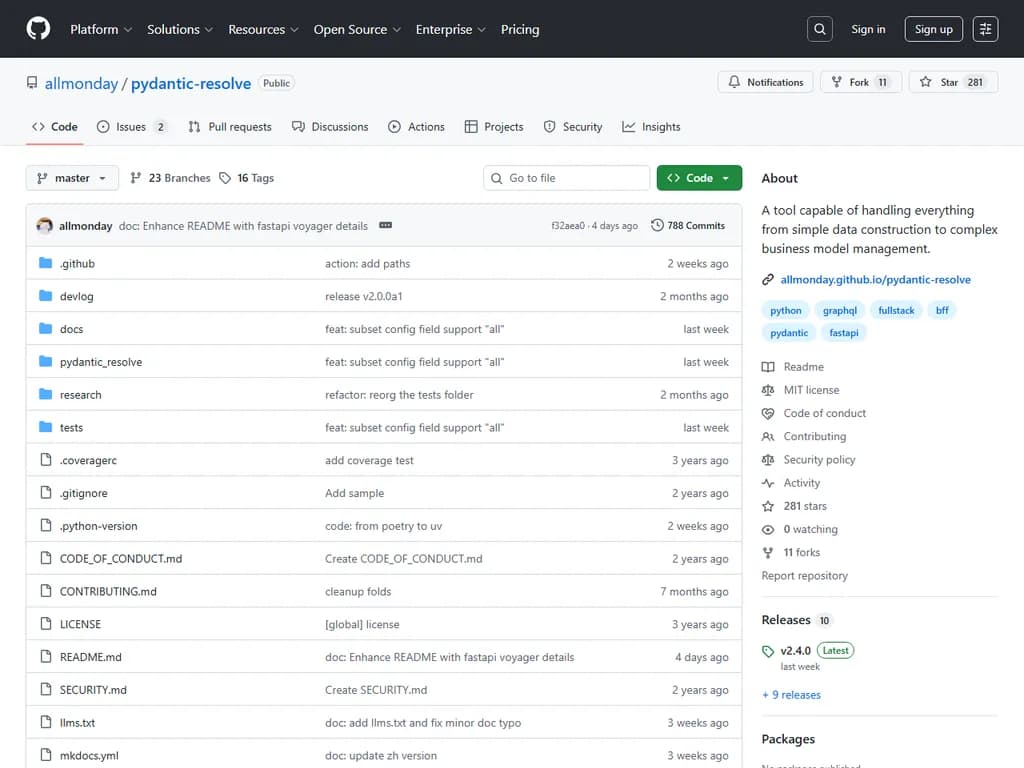
Pydantic-resolve is a Pydantic based approach to construct complex data declaratively and progressively, without writing any imperative glue code. Its best use case is building complex API data, especially in UI integration scenarios, it can be used as a replacement for GraphQL, reusing most of the code while offering better performance and maintainability. It introduces resolve methods for on-demand data fetching, and post methods for post process requirements. It also provides the capability for cross-layer node data transmission. Starting from pydantic-resolve v2, ErDiagram is supported, we can use it to declare application level Entity Relationship to better maintain the core business models. With the support of ERD, the constructed data will have better maintainability, being easy to write and read. It could be seamlessly integrated with modern Python web frameworks including FastAPI, Litestar, and Django-ninja. For FastAPI developers, we can visualize the dependencies of schemas by installing fastapi-voyager, visit live demo Installation
latest v1
pip install pydantic-resolve==1.13.5
v2
pip install pydantic-resolve
Starting from pydantic-resolve v1.11.0, both pydantic v1 and v2 are supported. Starting from pydantic-resolve v2.0.0, it only supports pydantic v2, pydantic v1 and dataclass are dropped, anything else are backward compatible. Basic Usage In this part, we will introduce some fundamental features that allow us to freely combine data just like a GraphQL query. Pick fields from source class DefineSubset can pick wanted fields and generate a new pydantic class. from pdyantic_resolve import DefineSubset import app.team.schema as team_schema
class Team(DefineSubset) subset = (team_schema.Team, ('id', 'name'))
@route.get('/teams', response_model=List[Team]) async def get_teams(session: AsyncSession = Depends(db.get_session)): teams = await tmq.get_teams(session) return teams Attach related data use resolve_{field} method and dataloader to efficiently fetch associated data Inside the dataloader is a simple batch-by-ids query. Of course, you can continue to take subsets of the associated data. from pydantic_resolve import Loader, Resolver import app.team.schema as team_schema import app.sprint.schema as sprint_schema import app.sprint.loader as sprint_loader import app.user.schema as user_schema import app.user.loader as user_loader
class Sprint(DefineSubset): subset = (sprint_schema.Sprint, ('id', 'name'))
class Team(DefineSubset) subset = (team_schema.Team, ('id', 'name'))
sprints: list[Sprint] = []
def resolve_sprints(self, loader=Loader(sprint_loader.team_to_sprint_loader)):
    return loader.load(self.id)

members: list[user_schema.User] = []
def resolve_members(self, loader=Loader(user_loader.team_to_user_loader)):
    return loader.load(self.id)
@route.get('/teams', response_model=List[Team]) async def get_teams(session: AsyncSession = Depends(db.get_session)): teams = await tmq.get_teams(session)
teams = [Team.model_validate(t) for t in teams] # <---
teams = await Resolver().resolve(teams)         # <---

return teams
Advanced Usage Here, we will introduce the advanced features of pydantic resolve, which can help resolve various issues during the data construction process(which are very difficult in scope of GraphQL). They are ErDiagram, post_{field} methods, ExposeAs and SendTo. Here is the live demo and source code
- Define schema (entity) and their relationships
for classes defined later, We can use string form to express.
from pydantic_resolve import base_entity, Relationship
BaseEntity = base_entity()
class Sprint(BaseModel, BaseEntity): relationships = [ Relationship( field='id', target_kls=list['Story'], loader=story_loader.sprint_to_story_loader) ]
id: int
name: str
status: str
team_id: int

model_config = ConfigDict(from_attributes=True)
class Story(BaseModel, BaseEntity): relationships = [ Relationship( field='id', target_kls=list['Task'], loader=task_loader.story_to_task_loader), Relationship( field='owner_id', target_kls='User', loader=user_loader.user_batch_loader) ]
id: int
name: str
owner_id: int
sprint_id: int

model_config = ConfigDict(from_attributes=True)
class Task(BaseModel): id: int name: str owner_id: int story_id: int estimate: int
model_config = ConfigDict(from_attributes=True)
class User(BaseModel): id: int name: str level: str
model_config = ConfigDict(from_attributes=True)
diagram = BaseEntity.get_diagram() config_global_resolver(diagram) # register into Resolver The dataloader is defined for general usage, if other approach such as ORM relationship is available, it can be easily replaced. DataLoader's implementation supports all kinds of data sources, from database queries to microservice RPC calls. Here we use SqlAlchemy. from .model import Task from sqlalchemy.ext.asyncio import AsyncSession from sqlalchemy import select import src.db as db from pydantic_resolve import build_list
--------- user_id -> user ----------
async def batch_get_users_by_ids(session: AsyncSession, user_ids: list[int]): users = (await session.execute(select(User).where(User.id.in_(user_ids)))).scalars().all() return users
async def user_batch_loader(user_ids: list[int]): async with db.async_session() as session: users = await batch_get_users_by_ids(session, user_ids) return build_object(users, user_ids, lambda u: u.id)
---------- task id -> task ------------
async def batch_get_tasks_by_ids(session: AsyncSession, story_ids: list[int]): users = (await session.execute(select(Task).where(Task.story_id.in_(story_ids)))).scalars().all() return users
async def story_to_task_loader(story_ids: list[int]): async with db.async_session() as session: tasks = await batch_get_tasks_by_ids(session, story_ids) return build_list(tasks, story_ids, lambda u: u.story_id) ErDiagram can also be declared seperately. diagram = ErDiagram( configs=[ ErConfig( kls=Story, relationships=[ Relationship( field='id', target_kls=list[Task], loader=task_loader.story_to_task_loader), Relationship( field='owner_id', target_kls=User, loader=user_loader.user_batch_loader) ] ), ErConfig( kls=Task, relationships=[ Relationship( field='owner_id', target_kls=User, loader=user_loader.user_batch_loader) ] ) ] )
config_global_resolver(diagram) # register into Resolver
- Attach related business data. As we introduced in basic usage section, we can simpliy inherit or use DefineSubset to reuse Entity fields and extends new field and resolve them by dataloaders. view in voyager As ErDiagram is provided, we don't need to write resolve methods, just provide the foreign key name in LoadBy, those methods will be compiled in analytic phase before execution. from pydantic_resolve import LoadBy
class Task(BaseTask): user: Annotated[Optional[BaseUser], LoadBy('owner_id')] = None
class Story(DefineSubset): subset = (BaseStory, ('id', 'name', 'owner_id'))
tasks: Annotated[list[Task], LoadBy('id')] = []
assignee: Annotated[Optional[BaseUser], LoadBy('owner_id')] = None
3. Adjust data for UI details The data you build in previous stage often is not directly ready for UI display. Many details require a second pass over the composed data, for example:
Task names need a prefix from their parent Story name A Story needs the total estimate of all its Tasks A Story needs to collect all developers involved across its Tasks
In Pydantic Resolve, these can be done with post_* methods immediately, without an extra traversal. From a lifecycle perspective, a Pydantic model's post_* methods run only after all resolve_* methods have finished. So from a post_* method, all resolved data is already ready. In other words, post_* is a hook provided during traversal, and you can use it to perform all kinds of operations after data fetching. Let's explain using the three cases above. 1: A node exposes its fields to all descendants
Task names need a prefix from their parent Story name
view in voyager, double click Story3 By defining pydantic_resolve_expose, you can expose the current model's field data to descendant nodes. pydantic_resolve_expose = { 'name': 'story_name' } Note: the key (name) is the field name, and the value (story_name) is an alias used by descendants to look up the value. This alias must be “globally” unique within the whole tree rooted at Story. Descendants can read the value via ancestor_context['story_name']. source code
post case 1
class Task3(BaseTask): user: Annotated[Optional[BaseUser], LoadBy('owner_id')] = None
fullname: str = ''
def post_fullname(self, ancestor_context):  # Access story.name from parent context
	return f'{ancestor_context["story_name"]} - {self.name}'
class Story3(DefineSubset): subset = (BaseStory, ('id', 'name', 'owner_id')) pydantic_resolve_expose = {'name': 'story_name'}
tasks: Annotated[list[Task3], LoadBy('id')] = []
assignee: Annotated[Optional[BaseUser], LoadBy('owner_id')] = None
Here is another way to define expose, SubsetConfig provides expose_as configuration. from pydantic_resolve import SubsetConfig
class Story3(DefineSubset): subset = SubsetConfig( kls=BaseStory, fields=['id', 'name', 'owner_id'], expose_as=[('name', 'story_name')])
tasks: Annotated[list[Task3], LoadBy('id')] = []
assignee: Annotated[Optional[BaseUser], LoadBy('owner_id')] = None
or use ExposeAs for normal scenarios from pydantic_resolve import ExposeAs
class Story3(BaseModel): id: int name: Annotated[str, ExposeAs('story_name')] # <--- owner_id: int sprint_id: int
tasks: Annotated[list[Task3], LoadBy('id')] = []
assignee: Annotated[Optional[BaseUser], LoadBy('owner_id')] = None

model_config = ConfigDict(from_attributes=True)
Note that fields processed by resolve/post cannot use expose as because the data is not yet ready.
In fastapi voyager, it will mark those expose as if we toggle on pydantic resolve meta and all descendents can access the value.
2: Compute extra fields from resolved data
How to compute the total estimate of all tasks in each story?
view in voyager, double click Story2 Because post_* runs after resolve_*, this is straightforward—just sum it. class Task2(BaseTask): user: Annotated[Optional[BaseUser], LoadBy('owner_id')] = None
class Story2(DefineSubset): pydantic_resolve_subset = (BaseStory, ('id', 'name', 'owner_id'))
tasks: Annotated[list[Task2], LoadBy('id')] = []
assignee: Annotated[Optional[BaseUser], LoadBy('owner_id')] = None

total_estimate: int = 0
def post_total_estimate(self):
	return sum(task.estimate for task in self.tasks)
3: An ancestor collects data from descendants
A story needs to collect all developers involved across its tasks
view in voyager, double click Task1, and view source code To implement collection, define a Collector in an ancestor node. Similar to expose, all descendants can send data to that Collector. Then read the results via collector.values(). Unlike expose, the alias inside a Collector does not need to be “globally” unique. Collectors with the same alias are scoped by the ancestor/descendant relationship. In descendant nodes, pydantic_resolve_collect = {'user': 'related_users'} declares that it will send user to the ancestor collector named related_users. pydantic_resolve_collect supports many forms:
send user to related_users
pydantic_resolve_collect = {'user': 'related_users'}
send user, id to related users
pydantic_resolve_collect = {('id', 'user'): 'related_users'}
send user, id to related_users and all_users
pydantic_resolve_collect = {('id', 'user'): ('related_users', 'all_users')}
The default Collector provided by Pydantic Resolve collects values into a list. You can also implement ICollector to build custom collectors for your own subset needs. For more details, view this page Here is the complete code. related_users will collect all user values. (Note: this example does not deduplicate.) class Task1(BaseTask): pydantic_resolve_collect = {'user': 'related_users'} # Propagate user to collector: 'related_users'
user: Annotated[Optional[BaseUser], LoadBy('owner_id')] = None
class Story1(DefineSubset): pydantic_resolve_subset = (BaseStory, ('id', 'name', 'owner_id'))
tasks: Annotated[list[Task1], LoadBy('id')] = []
assignee: Annotated[Optional[BaseUser], LoadBy('owner_id')] = None

related_users: list[BaseUser] = []
def post_related_users(self, collector=Collector(alias='related_users')):
	return collector.values()
Here is another option, use SendTo from pydantic_resolve import SendTo
class Task1(BaseTask): user: Annotated[Optional[BaseUser], LoadBy('owner_id'), SendTo('related_users')] = None
- Execute Pydantic Resolve provides Resolver().resolve(data) as the entry point. First, provide data of type Story. Then Resolver will execute your configured logic to fetch and transform data. from pydantic_resolve import Resolver
stories = [Story(**s) for s in await query_stories()] data = await Resolver().resolve(stories) How it works The process is similar to breadth-first traversal, with additional hooks after the traversal of descendant nodes is completed. Compared with GraphQL, both traverse descendant nodes recursively and support resolver functions and DataLoaders. The key difference is post-processing: from the post-processing perspective, resolved data is always ready for further transformation, regardless of whether it came from resolvers or initial input.
pydantic class can be initialized by deep nested data (which means descendant are provided in advance), then just need to run the post process.
Within post hooks, developers can read descendant data, adjust existing fields, compute derived fields. Post hooks also enable bidirectional data flow: they can read from ancestor nodes and push values up to ancestors, which is useful for adapting data to varied business requirements.
Documentation
Documentation: https://allmonday.github.io/pydantic-resolve/ Composition-Oriented Pattern: https://github.com/allmonday/composition-oriented-development-pattern Live demo: https://www.newsyeah.fun/voyager/?tag=sample_1 Resolver Pattern: A Better Alternative to GraphQL in BFF (api-integration).
Performance tips For projects using FastAPI + SQLAlchemy, you need to pay attention to the lifecycle of the session generated by Depends(async_session). When the number of concurrent requests is greater than or equal to the session pool size, a deadlock situation may occur. This is because the session provided by Depends waits until the end of the request to be released, while the dataloader in Resolver requests a new session, leading to a situation where new sessions cannot be acquired and existing ones cannot be released. The solution is to avoid long-term occupation of the Depends session and release it immediately after obtaining the required data. This also aligns with best practices: the lifecycle of a database session should be as short as possible. In terms of code examples, this means adding session.close(), or simply avoiding the use of sessions generated by Depends and using a context manager to control the session lifecycle directly. @router.get("/team/{team_id}/stories-with-mr", response_model=List[story_schema.StoryWithMr]) async def stories_with_mr_get( team_id: int, sprint_id: Optional[int] = None, session: AsyncSession = Depends(get_async_session)):
rows = await sq.get_stories(team_id=team_id, sprint_id=sprint_id, session=session)

# release session immediately after use
await session.close()

items = [story_schema.StoryWithMr.model_validate(r) for r in rows]
items = await Resolver().resolve(items)  # dataloader will create new session internally
return items
Development uv venv source .venv/bin/activate uv pip install -e ".[dev]"
uv run pytest tests/ Testing and Coverage
tox -e coverage python -m http.server Current test coverage: 97%