2025/12/26 23:06
C-events, yet another event loop, simpler, smaller, faster, safer
RSS: https://news.ycombinator.com/rss
要約▶
本文
Download ZIP Download TAR
      View On GitHub


    events
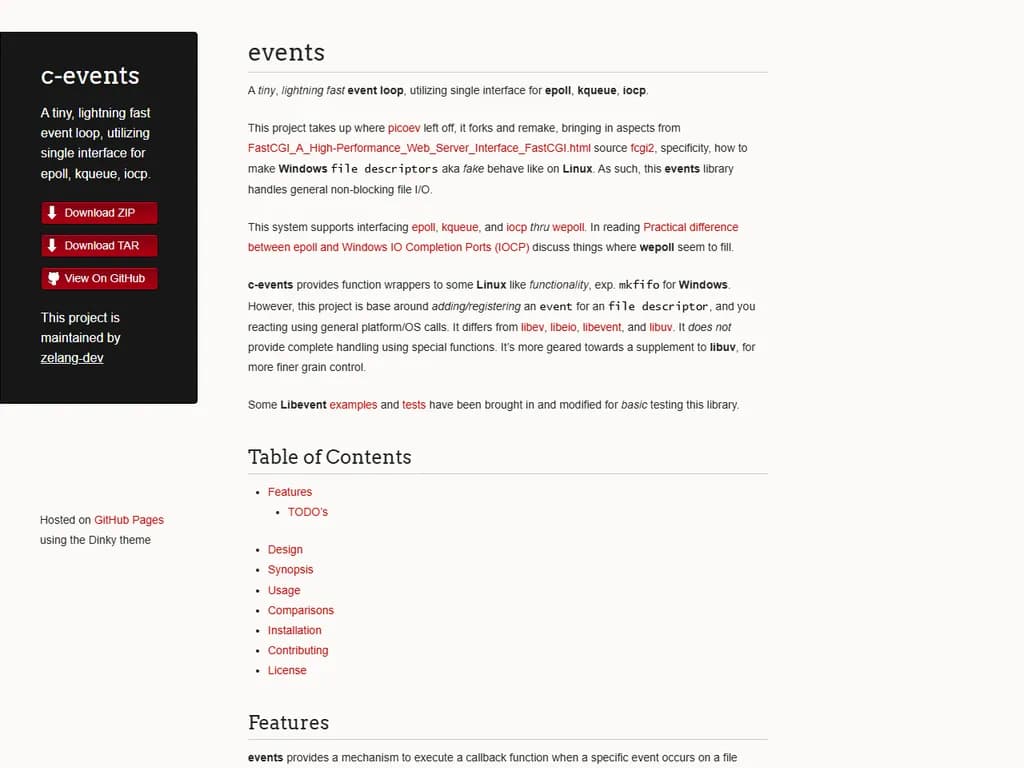
A tiny, lightning fast event loop, utilizing single interface for epoll, kqueue, iocp.
This project takes up where picoev left off, it forks and remake, bringing in aspects from FastCGI_A_High-Performance_Web_Server_Interface_FastCGI.html source fcgi2, specificity, how to make Windows file descriptors aka fake behave like on Linux. As such, this events library handles general non-blocking file I/O.
This system supports interfacing epoll, kqueue, and iocp thru wepoll. In reading Practical difference between epoll and Windows IO Completion Ports (IOCP) discuss things where wepoll seem to fill.
c-events provides function wrappers to some Linux like functionality, exp. mkfifo for Windows. However, this project is base around adding/registering an event for an file descriptor, and you reacting using general platform/OS calls. It differs from libev, libeio, libevent, and libuv. It does not provide complete handling using special functions. It’s more geared towards a supplement to libuv, for more finer grain control.
Some Libevent examples and tests have been brought in and modified for basic testing this library.
Table of Contents
Features
TODO’s
Design Synopsis Usage Comparisons Installation Contributing License
Features
events provides a mechanism to execute a callback function when a specific event occurs on a file descriptor or after a timeout has been reached. Every event represents a set of conditions, including:
A file descriptor being ready to read from or write to, events_add(loop, listen_sock, EVENTS_READ | EVENTS_WRITE, 0, accept_callback, NULL). A file descriptor has close, events_add(loop, listen_sock, EVENTS_READ | EVENTS_CLOSE, 0, accept_callback, NULL). A timeout expiring on file descriptor in 5 secods, events_add(loop, listen_sock, EVENTS_READ | EVENTS_TIMEOUT, 5, accept_callback, NULL). A signal occurring, events_add(loop, SIGINT, EVENTS_SIGNAL, 0, signal_cb, NULL). A user-triggered event, execute in 500 milliseconds, actor_t *actor = events_actor(loop, 500, actor_cb, NULL), events_repeat_actor(actor, seconds(2)), events_clear_actor(actor).
Once you call events_init(1024) and events_t *loop = events_create(60) functions to set up c-events and associate it with an event loop thread pool, it becomes initialized. At this point, you can add file descriptors, which makes it active in the loop.
When the conditions that would trigger an event occur (e.g., its file descriptor changes state or its timeout expires), the event becomes ready, and its (user-provided) callback function is run. All events are persistent, until events_del(listen_sock) is called, only user-triggered are one off, if not set to repeat. MUST call events_once(loop, 5) to monitor for changes, add a wait time in seconds, SHOULD be combined with events_is_running(loop) to ensure all events are captured.
TODO’s
Convert picoev API to Events API, this removes the select(2) part of code base.
Merge the non-assembly coroutine implementation from c-raii.
Merge wepoll, a epoll emulation for Windows.
Merge aspects of fcgi2, the pseudo file descriptors creation implementation.
Add/recreate tests and examples some derived from libevent.
Bug fix tests and examples for proper execution under Windows and Linux.
Bug fix tests and examples for proper execution under Apple macOS.
Complete implementation of events_addtasks_pool(), a thread pool creation function for Events API only.
Complete implementation of a Linux inotify_add_watch() function for Windows.
Complete implementation of inotify_add_watch() for Apple macOS.
Implement event EVENTS_FILEWATCH, EVENTS_DIRWATCH file descriptor condition, for handling inotify_add_watch().
Completion of ALL OS file system function routines with matching thread async_fs_ version.
Design
This implementation is similar to what I call an outline, how a coroutine should behave with an Event Loop interface, as described in libev THREADS, COROUTINES, CONTINUATIONS, QUEUES… INSTEAD OF CALLBACKS section.
The design layout is derived from the current work in progress in developing c-asio. This was initially setup to supplement usage of using libuv, since they document there Event Loop API handle isn’t really thread safe. Few things needed reimplementing, in doing so, it revealed, libuv has much overhead not needed, see Comparisons.
The basics of this project is base around the state of the file descriptor. In order to formulate execution of asynchrony aka concurrency, a coroutine like behavior is needed. It makes using epoll, kqueue or any multiplex interface system more effective. As just, all the additional memory allocations for structures not necessary. This includes another project c-raii, the coroutine aspect merged in, with a few things handled and named differently now, seems some bugs was addressed with unnecessary workarounds, but now fixed correctly with less work.
Most function signatures are the same, just passthru to the Operating System. In order to get cross-platform like behavior, many calls are macros pointing to internal functions to cache parameters, and redirect to correct OS routine, mostly for Windows.
The Operating System file descriptor is represented by fds_t and filefd_t. For Windows, this system will create a pseudo fd that actually has all Windows event system mechanisms attached. This action allows the creation of simpler a alternative Linux functions for Windows like mkfifo() IPC, and still in development inotify_add_watch() file/directory monitor, with same signatures. It’s also the basics for spawn() child process input/output control. The functions events_new_fd() and events_assign_fd() was mainly for Windows, but also available for Linux using eventfd interface, and Apple macOS using Darwin Notify functionality.
This would also allow nonblocking file system handling. But for cross-platform simplicity, everything is a pass-thru to a thread pool instead. A default of 1, which is automatically created with first events_create() loop events_t handle. An thread pool os_worker_t is created by calling events_add_pool() with a loop handle. The os_worker_t must be pass as first parameter to standard file system functions, a few currently implemented, all prefixed as async_fs_. These functions constructed as a wrapper call to queue_work() in coroutine to call thread handler. Using events_add_pool() is intended for FileSystem/CPU intensive workload offloading, NO actual Events API should be run in another thread, using this thread pool. That can be achieved using events_addtasks_pool(), see TODO’s.
The behavior/process of coroutine execution in c-raii is setup for automatically creating/moving and putting coroutines in different threads. In which intergrating libuv into c-asio that feature had to be completely disabled on first yield() encounter, it’s possibale, but reqquire more complexity or thread local storage introduction to libuv source, a major breaking change. Where events_addtasks_pool() create a os_tasks_t thread pool, will be for explicitly running Events API in another thread.
The following “simple TCP proxy” example demonstrate the simplicity of using events_add() by way of a async_wait() call. The read() and write() functions only has async_wait called added. These routines only work correctly when user set file descriptor to non-blocking. The standard process of creating a socket is in embedded in async_listener(), async_connect(), async_accept(), and are the only functions that will set non-blocking by default. Functions async_connect, async_accept includes a async_wait call.
Run:
tcp_proxy 1234 www.google.com 80
Then visit http://localhost:1234/ and see Google.
#include <events.h>
char *server; int local, port;
void *rwtask(param_t v) { int *a, rfd, wfd, n; char buf[2048];
a = v->int_ptr; rfd = a[0]; wfd = a[1]; free(a);
while ((n = async_read(rfd, buf, sizeof buf)) > 0) async_write(wfd, buf, n);
shutdown(wfd, SHUT_WR); close(rfd);
return 0; }
int *mkfd2(int fd1, int fd2) { int *a;
a = malloc(2 * sizeof a[0]); if (a == 0) { fprintf(stderr, "out of memory\n"); abort(); } a[0] = fd1; a[1] = fd2;
return a; }
void *proxytask(param_t v) { int fd, remotefd;
fd = v->integer; if ((remotefd = async_connect(server, port, true)) < 0) { perror("async_connect"); close(fd); return 0; }
fprintf(stderr, "\nconnected to %s:%d"CLR_LN, server, port);
async_task(rwtask, 1, mkfd2(fd, remotefd)); async_task(rwtask, 1, mkfd2(remotefd, fd));
return 0; }
void *main_main(param_t args) { fds_t cfd, fd; int rport; char remote[16];
local = atoi(args[0].char_ptr); server = args[1].char_ptr; port = atoi(args[2].char_ptr);
if ((fd = async_listener(OS_NULL, local, true)) < 0) { fprintf(stderr, "cannot listen on tcp port %d: %s\n", local, strerror(errno)); exit(1); }
while ((cfd = async_accept(fd, remote, &rport)) >= 0) { fprintf(stderr, "connection from %s:%d"CLR_LN, remote, rport); async_task(proxytask, 1, casting(cfd)); }
return 0; }
int main(int argc, char **argv) { if (argc != 4) { fprintf(stderr, "usage: tcpproxy localport server remoteport\n"); exit(1); }
events_init(1024); events_t *loop = events_create(6); async_task(main_main, 3, argv[1], argv[2], argv[3]); async_run(loop); events_destroy(loop);
return 0; }
Synopsis
/* Setup custom internal memory allocation handling. */ C_API int events_set_allocator(malloc_func, realloc_func, calloc_func, free_func);
/* Sets I/O on the given fd to be non-blocking. */ C_API int events_set_nonblocking(fds_t fd);
/* Creates a new event loop (defined by each backend). */ C_API events_t *events_create(int max_timeout);
/* Destroys a loop (defined by each backend). */ C_API int events_destroy(events_t *loop);
/* Initializes events. */ C_API int events_init(int max_fd);
/* Deinitializes events. */ C_API void events_deinit(void);
/* Registers a descriptor, with event, timeout, and callback argument to event loop. */ C_API int events_add(events_t *loop, fds_t sfd, int events, int timeout_in_secs, events_cb callback, void *);
/* Unregister a file descriptor from event loop. */ C_API int events_del(fds_t sfd);
/* Check if
fd/* Check if any
events/* Updates timeout. */ C_API void events_set_timeout(fds_t sfd, int secs);
/* Sets events to be watched for given desriptor. */ C_API int events_set_event(fds_t sfd, int event);
/* Execute
event loopmax_wait0numberevents-1/* Tries to query the system for current time using
MONOTONICREALTIME/**
- Set up for I/O descriptor masquerading.
- Entry in
is reserved to represent the socket/file.fdTable - @returns
-
an indexpseudo fd
, which masquerades as a UNIX-styleid
- "small non-negative integer" file/socket descriptor.
-
indicates failure.-1
*/ C_API int events_new_fd(FILE_TYPE type, int fd, int desiredFd);
/**
- Set pseudo FD to create the
I/O completion port on Windows - or
to seton Unix
to be used for async I/O.eventfd
*/ C_API bool events_assign_fd(filefd_t handle, int pseudo);
/**
- Free I/O descriptor entry in
. */ C_API void events_free_fd(int pseudo); C_API uint32_t events_get_fd(int pseudo); C_API bool events_valid_fd(int pseudo); C_API int events_pseudo_fd(const char *name); C_API void events_abort(const char *message, const char *file, int line, const char *function);fdTable
/* Suspends the execution of current
Generator/Coroutineyieldtaskyielded()/* Creates an
Generator taskyielding()yielded()/* Resume specified generator task, returning data from
yielding/* Return
generator idyielded()/* Return handle to current
task/* Yield execution to another
taskNOTE: This switches to thread schedular
run queueexecutetask/* Suspends the execution of current
task/* Explicitly give up the CPU for at least ms milliseconds. Other tasks continue to run during this time.
- returns the actual amount of time slept, in milliseconds.
NOTE: Current
tasksleepthreadrun queuems/* Returns result of an completed
taskresult idtask_is_ready()task_is_terminated()/* Creates/initialize the next series/collection of
task'stask groupwaitGroupsAll
taskThe initialization ends when
tasks_wait()tasktasks/* Pauses current
tasktaskstask_group_tReturns
arrayresults idresults_for()/* Return the unique
result idtask/* Check for
task/* Check for
task/* Print an
taskdebug/* Return
current/* Set tasks
user_datataskthis/* Get tasks
user_datataskthis/* Sets the current
task's/* Check for at least
nabort/* Register an
event loopnewos_worker_tblocking/* Return
current/* This runs the function
fnthrdtaskresult idSimilar to: https://en.cppreference.com/w/cpp/thread/async.html https://en.cppreference.com/w/cpp/thread/packaged_task.html
MUST call
await_for()NOTE: This is setup to be just an
pass thru/* This waits aka
yieldresult idqueue_work()Similar to: https://en.cppreference.com/w/cpp/thread/future/get.html and https://en.cppreference.com/w/cpp/thread/future/valid.html */ C_API values_t await_for(uint32_t id);
/* Creates and returns an
result idtaskfunctionnumberargumentsNOTE: The
taskcurrentrun queueGo/* Low-level call sitting underneath
async_readasync_writefdrw- 'r' means read
- 'w' means write
Anything else means just exceptional conditions (hang up, etc.) The
'r''w'/* Run until there are no more
tasksloop/** Like regular
read()/** Like
async_read()async_wait()/** Like regular
write()/** Start a network listener
serverportproto_tcpThe address is a string version of a
host nameIPhost nameasync_gethostbyname()port- Returns a
to use withfd
. */ C_API fds_t async_listener(char *server, int port, bool proto_tcp);async_accept()
/** Sleep
currentclientfd- If
not NULL, it MUST be a buffer ofserver
to hold remote IP address.16 bytes - If
not NULL, it's filled with report port.port
Returns a
connectedfdtask/** Create a new connection to
hostnameproto_tcp- Hostname can be an
address or aip
.domain name - If
, automatically callsdomain name
to preform a non-blocking DNS lockup. */ C_API fds_t async_connect(char *hostname, int port, bool proto_tcp);async_gethostbyname()
/* Return
ipasync_gethostbyname()/** Preform a non-blocking DNS lockup in separate
thrdhostent/** Preform a non-blocking DNS lockup in separate
threadhostentC_API int async_get_addrinfo(os_worker_t *thrd, const char *name, const char *service, const struct addrinfo *hints, addrinfo_t result);
C_API int async_getaddrinfo(const char *name, const char *service, const struct addrinfo *hints, addrinfo_t result);
C_API int async_fs_open(os_worker_t *thrd, const char *path, int flag, int mode); C_API int fs_open(const char *path, int flag, int mode);
C_API int async_fs_read(os_worker_t *thrd, int fd, void *buf, uint32_t count); C_API int fs_read(int fd, void *buf, uint32_t count);
C_API int async_fs_write(os_worker_t *thrd, int fd, const void *buf, uint32_t count); C_API int fs_write(int fd, const void *buf, uint32_t count);
C_API ssize_t async_fs_sendfile(os_worker_t *thrd, int fd_out, int fd_in, off_t *offset, size_t length); C_API ssize_t fs_sendfile(int fd_out, int fd_in, off_t *offset, size_t length);
C_API int async_fs_close(os_worker_t *thrd, int fd); C_API int fs_close(int fd);
C_API int async_fs_unlink(os_worker_t *thrd, const char *path); C_API int fs_unlink(const char *path);
C_API int async_fs_stat(os_worker_t *thrd, const char *path, struct stat *st); C_API int fs_stat(const char *path, struct stat *st);
C_API int async_fs_access(os_worker_t *thrd, const char *path, int mode); C_API int fs_access(const char *path, int mode);
C_API bool fs_exists(const char *path); C_API size_t fs_filesize(const char *path);
C_API execinfo_t *spawn(const char *command, const char *args, spawn_cb io_func, exit_cb exit_func); C_API uintptr_t spawn_pid(execinfo_t *child); C_API bool spawn_is_finish(execinfo_t *child);
Usage
Besides all code snippets above, this example recreate Google’s waitGroups of goroutine’s.
#include "events.h"
void *worker(param_t args) { int id = args[0].integer; printf("Worker %d starting, task id: #%d\n", id, task_id());
sleep_task(seconds(1));
printf(LN_CLR"Worker %d done, task id: #%d\n", id, task_id()); return 0; }
void *main_main(param_t args) { int i;
task_group_t *wg = task_group(); for (i = 1; i <= 5; i++) { async_task(worker, 1, i); } tasks_wait(wg);
return 0; }
int main(int argc, char **argv) { events_init(1024); async_task(main_main, 0); events_t *loop = events_create(6); async_run(loop); events_destroy(loop);
return 0; }
package main
import ( "fmt" "sync" "time" )
func worker(id int) { fmt.Printf("Worker %d starting\n", id)
time.Sleep(time.Second)
fmt.Printf("Worker %d done\n", id) }
func main() {
var wg sync.WaitGroup
for i := 1; i <= 5; i++ { wg.Add(1)
i := i
go func() { defer wg.Done() worker(i) }() }
wg.Wait() }
Comparisons
Same functions and behavior of Linux’s mkfifo for Windows also, minor changes in libevent event-read-fifo sample, where it states Windows sections don’t work.
#include "events.h"
static void fifo_read(fds_t fd, int event, void *arg) { char buf[255]; int len;
fprintf(stderr, "fifo_read called with fd: %d, event: %d, arg: %p\n", socket2fd(fd), event, arg); len = read(fd, buf, sizeof(buf) - 1); if (len <= 0) { if (len == -1) perror("read"); else if (len == 0) fprintf(stderr, "Connection closed\n"); events_del(fd); return; }
buf[len] = '\0'; fprintf(stdout, "Read: %s\n", buf); }
static void signal_cb(fds_t sig, int event, void *arg) { events_t *loop = events_loop(sig); unlink(mkfifo_name()); events_destroy(loop); }
int main(int argc, char **argv) { events_t *base; struct stat st; const char *fifo = "event.fifo"; int socket;
if (lstat(fifo, &st) == 0) { if ((st.st_mode & S_IFMT) == S_IFREG) { errno = EEXIST; perror("lstat"); exit(1); } }
unlink(fifo); if (mkfifo(fifo, 0600) == -1) { perror("mkfifo"); exit(1); }
/* Initialize the event library */ base = events_create(6);
socket = open(fifo, O_RDWR | O_NONBLOCK, 0); if (socket == -1) { perror("open"); unlink(mkfifo_name()); events_destroy(base); exit(1); }
fprintf(stderr, "Write data to %s\n", mkfifo_name());
/* catch SIGINT so that event.fifo can be cleaned up*/ events_add(base, SIGINT, EVENTS_SIGNAL, 0, signal_cb, NULL);
/* Initialize one event */ events_add(base, socket, EVENTS_READ, 0, fifo_read, NULL);
while (events_is_running(base)) { events_once(base, 1); }
close(socket); unlink(fifo); events_destroy(base);
return (0); }
A much simpler version of libuv dns example. This is same as c-asio https://github.com/zelang-dev/c-asio/tree/main/examples/dns.c intergrating libuv.
#include "events.h"
void *main_main(param_t args) { char text[1024] = {0}; int len; fprintf(stderr, "irc.libera.chat is..."CLR_LN); struct hostent *dns = async_gethostbyname("irc.libera.chat");
fprintf(stderr, "%s"CLR_LN, gethostbyname_ip(dns)); fds_t server = async_connect(gethostbyname_ip(dns), 6667, true); while ((len = async_read(server, text, sizeof(text)) > 0)) { fprintf(stderr, CLR"%s", text); memset(text, 0, sizeof(text)); }
return 0; }
int main(int argc, char **argv) { events_init(1024); events_t *loop = events_create(6); async_task(main_main, 0); async_run(loop); events_destroy(loop);
return 0; }
A much simpler version of libuv uvcat example. This is same as c-asio https://github.com/zelang-dev/c-asio/tree/main/examples/uvcat.c intergrating libuv.
#include "events.h"
void *main_main(param_t args) { char text[1024]; int len, fd = fs_open(args[0].const_char_ptr, O_RDONLY, 0); if (fd > 0) { if ((len = fs_read(fd, text, sizeof(text))) > 0) fs_write(STDOUT_FILENO, text, len);
return casting(fs_close(fd)); }
return casting(fd); }
int main(int argc, char **argv) { if (argc < 2) { fprintf(stderr, "usage: _cat filepath\n"); exit(1); }
events_init(1024); events_t *loop = events_create(6); async_task(main_main, 1, argv[1]); async_run(loop); events_destroy(loop);
printf(LN_CLR CLR_LN); return 0; }
A much simpler version of libuv spawn example. This is same as c-asio https://github.com/zelang-dev/c-asio/tree/main/examples/spawn.c intergrating libuv.
#include "events.h"
void _on_exit(int exit_status, int term_signal) { fprintf(stderr, "\nProcess exited with status %d, signal %d\n", exit_status, term_signal); }
void *main_main(param_t args) { execinfo_t *child = spawn("child_command", "test-dir", NULL, _on_exit); if (child != NULL) { fprintf(stderr, "\nLaunched process with ID %zu\n", spawn_pid(child)); while (!spawn_is_finish(child)) yield_task(); }
return 0; }
int main(int argc, char **argv) { events_init(1024); events_t *loop = events_create(1); async_task(main_main, 0); async_run(loop); events_destroy(loop);
return 0; }
Installation
Any commit with an tag is considered stable for release at that version point.
If there are no binary available for your platform under Releases then build using cmake, which produces static libraries by default.
Linux
mkdir build cd build cmake .. -DCMAKE_BUILD_TYPE=Debug/Release -D BUILD_TESTS=OFF -D BUILD_EXAMPLES=OFF # use to not build tests and examples cmake --build .
Windows
mkdir build cd build cmake .. -D BUILD_TESTS=OFF -D BUILD_EXAMPLES=OFF # use to not build tests and examples cmake --build . --config Debug/Release
As cmake project dependency
For CMake versions earlier than 3.14, see https://cmake.org/cmake/help/v3.14/module/FetchContent.html
Add to CMakeLists.txt
find_package(events QUIET) if(NOT events_FOUND) FetchContent_Declare(events URL https://github.com/zelang-dev/c-events/archive/refs/tags/0.1.1.zip URL_MD5 e2ec8e145bc702b052fe857d03c95c31 ) FetchContent_MakeAvailable(events) endif()
target_include_directories(your_project PUBLIC $<BUILD_INTERFACE:${EVENTS_INCLUDE_DIR} $<INSTALL_INTERFACE:${EVENTS_INCLUDE_DIR}) target_link_libraries(your_project PUBLIC events)
Contributing
Contributions are encouraged and welcome; I am always happy to get feedback or pull requests on Github :) Create Github Issues for bugs and new features and comment on the ones you are interested in.
License
The MIT License (MIT). Please see License File for more information.